Horror has always loved the doppelgänger. Two people with the same face makes the audience unsettled before anything scary happens. The Substance makes that old idea sharper by asking what happens when the second you is younger, thinner, more marketable, and immediately everyone prefers her. It is not a ghost story.
It is a story about what happens to women who are told they can only stay visible if they become someone else. Coralie Fargeat builds that idea on the body of one woman, former TV fitness star Elisabeth Sparkle, played by Demi Moore, and she refuses to blink while it gets messy.
A Desperate Woman And an Offer She Cannot Refuse
Elisabeth has already been pushed out by her boss, the oiled and sleazy Harvey, played with cheerful cruelty by Dennis Quaid. He replaces her because a younger body will get more viewers. That humiliation sends her toward a secret procedure known only as the Substance, a treatment that promises to create a new version of you, the perfect version, the one the camera will love again.
Industry chatter in 2024 and 2025 framed it as a satirical update on diet pills and injectables, which is exactly how the film wants you to see it. It is a product sold to a woman who has been told she is expiring.
The Rules That Turn Beauty into Horror
The catch is simple. You and your clone must share time. One week you are in charge, one week she is. If you break the schedule, the original body starts to rot. The movie says this plainly and then makes us watch Elisabeth fail at it, because how could she not.
Her double, Sue, played by Margaret Qualley, is immediately adored. She is supple, bouncy, impossibly perky, a woman written by a casting director who has never aged a day in his life. Elisabeth is supposed to go back to the shadows while Sue enjoys success. Every time Elisabeth tries to hold on to visibility, the penalty is written on her skin. Visibility is a zero sum game. If the younger woman is seen, the older one must fall apart.
The Clone as The Real Woman
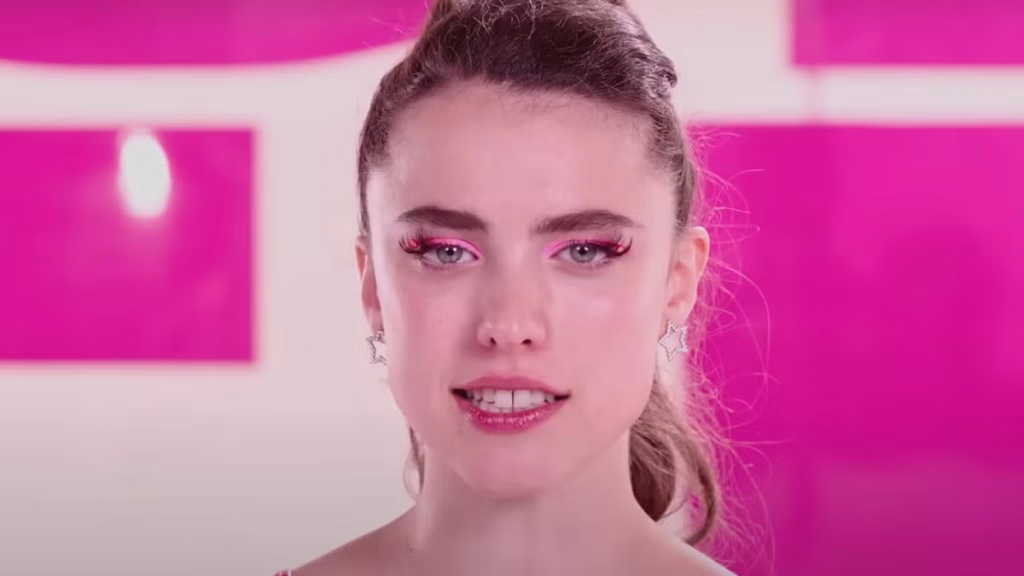
Here is where the title of your piece lives. The movie keeps hinting that Sue is not a fake. She is the woman everyone said Elisabeth should have been and is what the beauty industry wants. She is what TV wants, and what Harvey wants to parade in neon leotards.
Which means Elisabeth becomes a leftover. A test run. A body that did the emotional labor, the dieting, the smiling through live television, so that Sue could arrive fully formed. That is the scariest part. The monster is not the clone. The monster is the system that decides which version of a woman counts.
Coralie Fargeat’s Feminist Body Horror
Fargeat, who already showed in Revenge that she likes her violence extreme and her messages loud, treats the female body like a battlefield again. She uses gallons of prosthetics, elastic skin, bone snapping, and late film grotesquerie to make sure we understand that chasing ideal beauty is not clean. It costs tissue, and dignity.
It costs time. Interviews around the awards push made it clear she saw the film as a direct hit on how Hollywood treats aging actresses, which is why casting Demi Moore at this point in her career is so sharp. The star who once had to fight for leading roles in a youth obsessed market now gets to play the woman being fed through the grinder.
Margaret Qualley as The Bright Hungry Copy

Qualley has the trickier job. She has to be delightful and terrifying in the same breath. Her Sue is friendly, even grateful, but every gesture says she enjoys being adored. She is the child of social media and male fantasy, made in a lab for ratings. When Sue starts to push for more than her allotted week, it shifts the story from body horror into psychological horror.
We realize the copy is not only more visible, she is more ambitious. Why should she go back into storage when everyone wants her. The double is the modern monster because she wants permanence. She wants the career, the apartment, the screens, the applause. She wants to take up all the space.
Age, Self-Worth, and the Cult of Upgrade
What the film keeps circling is an ugly cultural belief. If a woman can be upgraded, then the previous version must be thrown away. That is why the decay sequences are so long. We have to sit with what it looks like when a woman tries to exist beside her own improvement. It is pitiful, then angry, then violent.
The story is saying that if you tell women long enough that only one ideal body is allowed, you should not act surprised when they do something extreme to stay in it. The Substance is simply a science fiction version of the surgery, the pills, the punishing workouts, the filters. It is all the same transaction, only this time the body refuses to hide the cost.
The Feminine Double Across Modern Horror
This idea of the feminine double has been creeping across film for a while, but The Substance makes it literal. It is very different from stories where two women compete for a role or where a younger actress replaces an older one. Here they are the same person.
Which means the rivalry is an internal one. Self love is at war with market love. Elisabeth may know she has value, but she also knows the culture only sees Sue. That split is the modern monster. It is not a ghoul in the woods. It is a woman who knows her worth and still thinks a younger version of herself would be worth more.

Rachel Sikkema is a New Zealand-based writer and creative entrepreneur who explores the intersection of film, culture, and modern relationships. Through her articles, she examines how stories shape the way we connect, love and see ourselves – all for God’s glory. When she’s not writing about film and television, she’s watching Dexter and The White Lotus for the third time.