There are movies that make your palms sweat because something scary might happen, eventually. And then there’s Uncut Gems, which starts sweating for you and never stops. It treats anxiety less like a mood and more like a competitive event, complete with a scoreboard, momentum swings, and the kind of reckless confidence that makes you yell at the screen while knowing you’d do the exact same thing if you were wired like Howard Ratner.
The trick is that the film never frames stress as an unfortunate side effect. Stress is the point. It’s the drug. And watching Howard chase that feeling is like watching someone turn their own nervous system into an arcade game they cannot walk away from.
It Opens by Telling You What Kind of Ride This Is
The movie begins far from New York, in an Ethiopian mine, then pulls a visual trick that feels like the film’s mission statement: it collapses the distance between the cosmic and the bodily, the gemstone and the flesh. You immediately understand that what looks shiny and valuable will also be claustrophobic and cruel.
That opening matters because it frames the opal as more than a MacGuffin. The stone becomes a promise Howard can’t stop believing in, even when reality keeps sending him increasingly bold warning texts in the form of angry loan sharks and locked doors.
Howard Ratner Runs on Momentum, Not Logic
Howard Ratner (Adam Sandler) isn’t “bad at decisions” in a normal, relatable way. He’s bad at stopping. He lives in the space between a risky idea and the next risky idea, where the brain goes, We’re already in motion, so it would be weird to become responsible now.
He doesn’t gamble because he needs money. He gambles because he needs a storyline where he is always one move away from becoming the guy he thinks he already is. Every wager is a little rewrite of his identity: respected dealer, big-shot connector, genius who saw value before anyone else did.
The Diamond District Feels Like a Contact Sport
The setting doesn’t just look stressful. It behaves stressful. The Diamond District is packed, fluorescent, loud, and transactional in a way that makes every conversation sound like an argument, even when it’s technically a greeting. Howard’s shop becomes a tiny arena where people crowd each other, talk over each other, and negotiate like they’re fighting for oxygen.
That constant friction turns ordinary interactions into mini-competitions. Howard haggles, flatters, lies, improvises, and performs. He treats every relationship like leverage. He can’t help it. If someone is in front of him, he looks for the angle.
The Film’s Sound Turns Conversation Into Pressure
A huge part of the anxiety comes from how Uncut Gems handles sound and dialogue. People overlap. Phones ring. Someone is always interrupting. Howard talks like he’s trying to outrun consequences with syllables.
This isn’t random chaos. The movie uses noise as a tactic. If Howard can keep talking, he can keep the world from pinning him down. If he can keep everyone spinning, maybe nobody will notice the math doesn’t work. The sound design makes you feel that strategy in your body, because you start craving quiet the way you crave water after eating something too salty.
The Camera Refuses to Give You Breathing Room
Visually, the film sticks close to Howard. It crowds him the way his life crowds him. Cinematographer Darius Khondji shoots New York with a tense, shimmering grit that makes luxury feel sticky instead of elegant.
Even when the film widens out, it doesn’t relax. It just shows you a bigger version of the trap. The jewelry, the suits, the NBA access, the backstage passes. None of it reads as freedom. It reads as more surfaces to bounce off when the panic ricochets.
This is where the “anxiety as sport” idea clicks: the movie shoots Howard like an athlete who never leaves the play. No timeouts. No locker room. No halftime pep talk. Just continuous motion until the body gives out.
The Score Turns Panic Into Rhythm
What’s brilliant is how the score doesn’t simply underline tension. It gives tension a beat. That’s the “sport” transformation. The anxiety becomes kinetic, almost musical, like Howard is dancing on the edge of disaster and the soundtrack is keeping tempo.
Sometimes the music feels euphoric, which is unsettling on purpose. It mirrors Howard’s internal experience. He hears the same chaos you hear, but he interprets it as possibility. The score seduces you into understanding how addiction can feel like motivation when you’re inside it.
Kevin Garnett Isn’t a Cameo, He’s Part of the Mechanism

Kevin Garnett playing himself anchors the movie’s gambling arc in something concrete: a real-world competitive environment where momentum and superstition already feel normal.
Howard’s obsession with Garnett isn’t just fandom. It’s projection. He treats Garnett like proof that intensity equals destiny. If Garnett believes in the opal’s “energy,” then Howard’s belief system stops sounding like pure delusion and starts sounding like a mindset. The kind people pay to hear in motivational speeches.
The Women in His Life See the Pattern Clearly, and It Changes Nothing
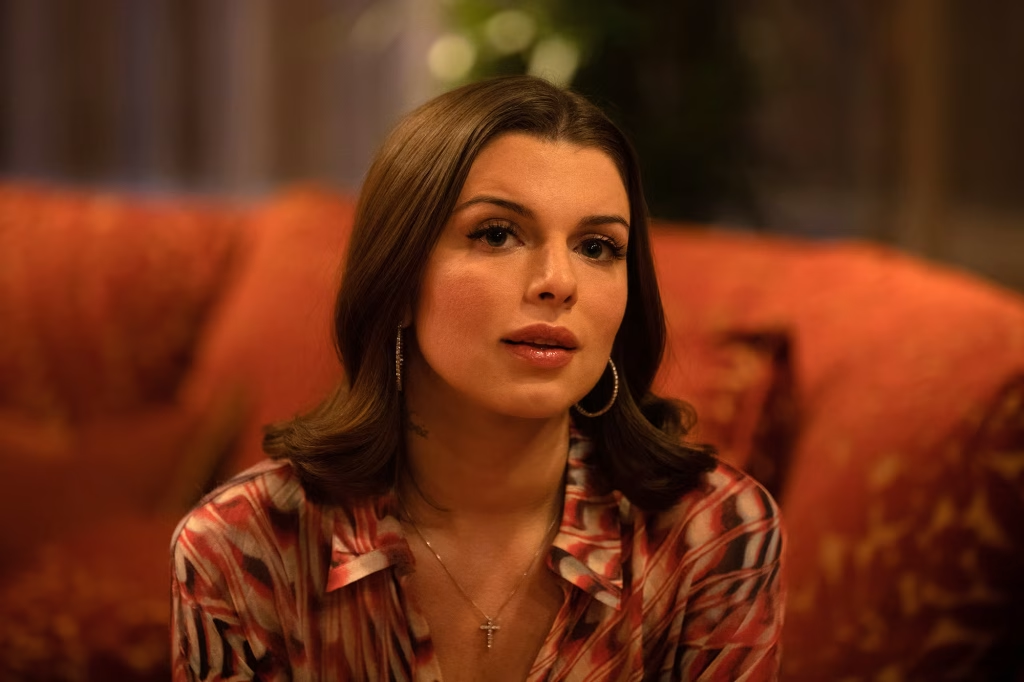
Howard’s marriage to Dinah (Idina Menzel) and his relationship with Julia (Julia Fox) reveal two different kinds of pressure: the domestic kind that has calcified into resentment, and the romantic kind that still feels like a gamble he might win.
Dinah doesn’t need to “discover” Howard’s flaws. She lives with the consequences. Her exhaustion becomes its own form of tension because it’s calm, contained, and permanent. Julia, meanwhile, understands Howard’s chaos but stays close enough to get burned, because the ride can look like loyalty when it’s moving fast.
The Movie Makes You Feel Complicit, and That’s the Nastiest Part
Here’s the uncomfortable confession: the film makes Howard’s confidence infectious. You watch him talk his way out of impossible situations and you start thinking, Okay, maybe he can pull this off. The movie gives you just enough temporary success to make the next bad choice feel, in the moment, like a strategy instead of a spiral.
That’s how sports fandom works too. You keep believing because belief is part of the experience. You ride the highs, you rationalize the mess, and you stay for the next possession.
Howard isn’t a hero, but he’s an engine. And the film dares you to enjoy the speed while knowing the crash is built in.

Rachel Sikkema is a New Zealand-based writer and creative entrepreneur who explores the intersection of film, culture, and modern relationships. Through her articles, she examines how stories shape the way we connect, love and see ourselves – all for God’s glory. When she’s not writing about film and television, she’s watching Dexter and The White Lotus for the third time.