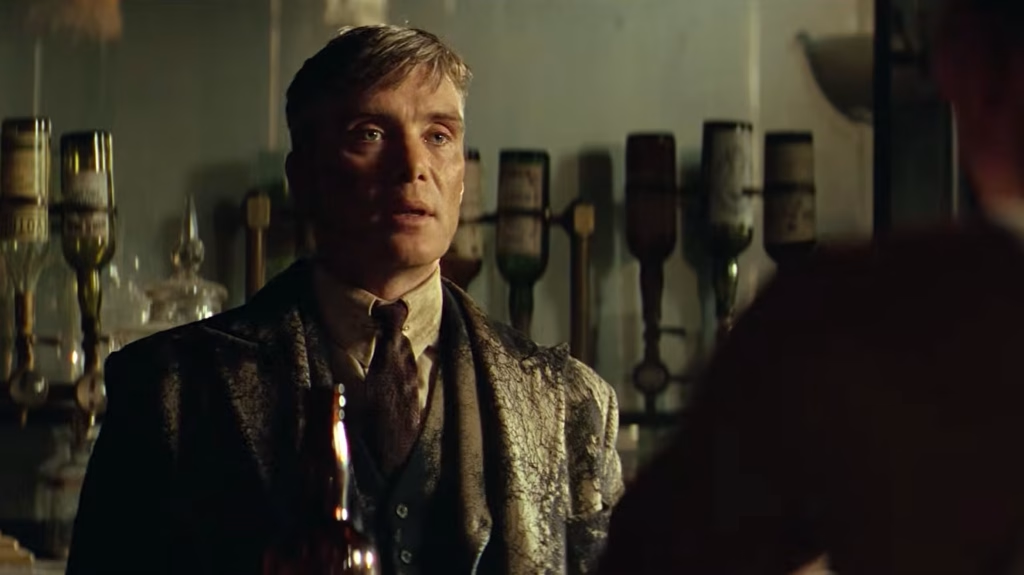
Tommy Shelby has always been written like a man the world can’t quite hold. That was true in the original Peaky Blinders series, and it becomes even clearer in Peaky Blinders: The Immortal Man. The film pushes him beyond the usual crime-boss frame and into something stranger. By this point, Tommy is no longer just a person making decisions.
He’s a story people tell themselves about power, survival, fear, and destiny. The movie leans into that idea hard. Honestly, it’s the smartest thing it could have done. It also continues the story with new figures around him, including Duke Shelby, played by Barry Keoghan.
Tommy Was Always Built Like a Legend
From the beginning, Tommy never moved through Birmingham like an ordinary man. He entered rooms as if he’d already seen the ending. He spoke in short, careful lines that sounded less like conversation and more like prophecy. Other characters reacted to him that way too. They feared him, followed him, loved him, and resented him. In some cases treated him like a force of nature rather than a brother or a boss.
That matters because myth doesn’t appear out of nowhere. It grows when enough people stop seeing the person clearly. Tommy’s rise was never only about money or gang power. It was about presence. He understood theatre. He knew how to use silence, clothes, ritual, and timing until the man himself almost disappeared behind the image.
Cillian Murphy has always played that split beautifully. You can see Tommy thinking, hurting, calculating, and fraying at the edges. However, the face he shows the world is carved from stone. That tension is what made him fascinating in the first place. He felt human, but only in flashes. The rest of the time he felt invented by his own reputation.
The New Film Treats Tommy Like a Symbol
The Immortal Man seems to understand that Tommy can’t just return as a familiar gangster and still feel interesting. A straight victory lap would’ve been dull. The film instead treats him like a figure whose legend has outgrown his body, which is a much richer idea.
That title says a lot. “The Immortal Man” was never likely to mean literal immortality. It points to the way Tommy survives in memory, rumor, influence, and inheritance. Men like him don’t stay alive because they’re untouched. They stay alive because they change the people around them so deeply that even their absence keeps shaping the room.
That’s why the father-son angle matters so much here. Reported details around the film have made clear that Tommy’s relationship with Duke sits close to the emotional center of the story, and that feels exactly right. A myth becomes real when it gets passed down. The son doesn’t just inherit the business. He inherits the weight of the name, the damage inside it, and the impossible standard attached to it.
Power Turned Tommy Into an Idea

The more power Tommy Shelby gained, the less accessible he became. That’s often the trade. Once a person becomes the center of an empire, everyone around them starts responding to the position instead of the person.
Tommy represents control, especially in a world built on chaos. He walks into instability and makes it look manageable. Even when he’s unraveling, he performs certainty. That performance becomes contagious. Soon everyone else needs him to be the version of Tommy they believe in. The family needs the strategist. Enemies need the monster. Loyalists need the leader. The myth gets fed from all sides.
And then there’s the darker truth. Myth is useful because it protects vulnerability. Tommy can’t function if everyone sees the frightened, grieving, traumatized man underneath. So he turns himself into a symbol because symbols are harder to wound. The problem, of course, is that symbols can’t rest either.
Family Is What Makes the Myth Tragic
What has always separated Peaky Blinders from thinner gangster stories is that the family drama carries the real emotional charge. The violence matters, the politics matter, the ambition matters. However, the deepest cuts usually happen at the dinner table, or in the silences between siblings.
That pattern seems to continue in the film. Even recent coverage around The Immortal Man has stressed that the story comes back to family, especially the bond and tension between Tommy and Duke. That choice keeps Tommy from turning into a cold statue. It reminds us that myths are hardest on the people who have to live near them.
There’s also something painfully fitting about Tommy becoming most mythic at the point where he is least reachable. Family members don’t get the legend. They get the consequences. Ada Shelby, played again by Sophie Rundle, understands him better than most. However, even she often stands at a slight distance from whatever version of Tommy has taken over the room. That gap between the public figure and the private man is where the tragedy sits.
Tommy’s Control Was Never as Complete as It Looked
This is the quiet irony of the character. Tommy built his identity around mastery. He plans, anticipates, manipulates, and endures. But the myth of Tommy Shelby has always been more stable than the man himself.
Underneath all the poise, he’s deeply reactive. He’s driven by war trauma, grief, guilt, and the need to outrun whatever is waiting in his own head. That gives the character his charge. He looks like someone commanding history, but often he’s just surviving it in a more elegant suit than everyone else.
That’s part of why audiences stay hooked. Perfection is boring. Tommy isn’t perfect. He’s haunted. The myth says he’s untouchable. The man keeps bleeding through.
The Ending of Tommy’s Story Almost Had to Go This Way

Recent reporting around the film makes it clear that this chapter was conceived as a conclusion to Tommy’s arc. That choice makes sense on a character level. Once someone becomes more myth than man, there are only so many places left to go. You either strip the legend away or show how it outlives the body. The Immortal Man appears far more interested in the second option.
That’s also why Tommy remains such a durable character in pop culture. He works as a gangster, yes, but he lasts as an idea. He speaks to the fantasy of absolute composure under pressure. He also exposes the cost of living that way. The cap, the coat, the stare, the voice, the horse imagery, the sense that every entrance means something bigger is happening: all of it turns him into folklore.
And maybe that was always the destination. Tommy Shelby could never stay a regular man once the world around him started using him as proof that fear can be weaponized.
That’s what makes him memorable. He became the kind of man people keep talking about long after the room has emptied. Tommy Shelby survives because the legend does. In The Immortal Man, that may be the whole point.

Rachel Sikkema is a New Zealand-based writer and creative entrepreneur who explores the intersection of film, culture, and modern relationships. Through her articles, she examines how stories shape the way we connect, love and see ourselves – all for God’s glory. When she’s not writing about film and television, she’s watching Dexter and The White Lotus for the third time.