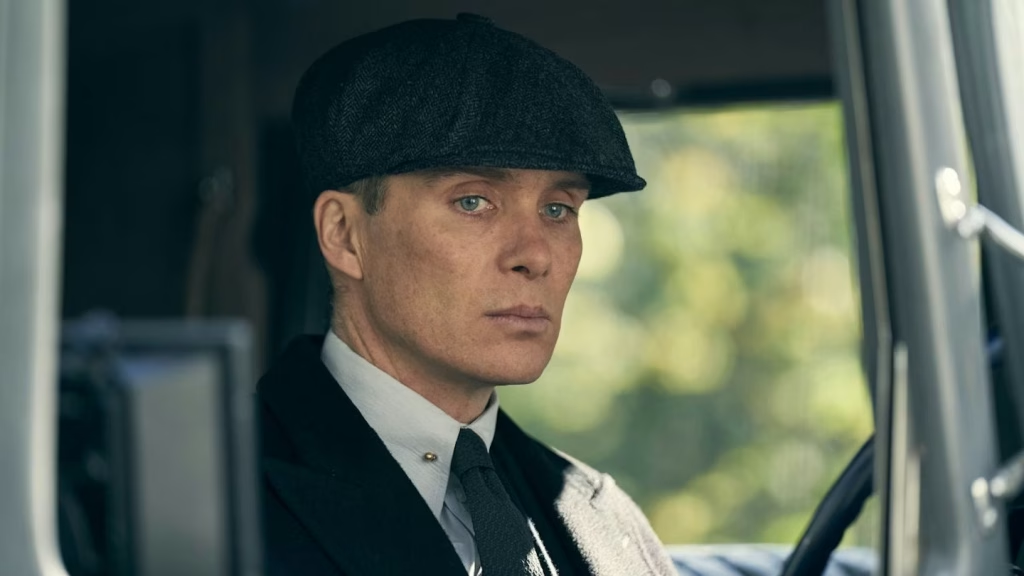
By the time Peaky Blinders: The Immortal Man arrives, Tommy Shelby is already more than a character. He is a presence, a legend, a walking storm cloud in a good coat. Cillian Murphy has played him for so long that it would almost be strange if one film could truly close the book. And that is really the point.
Even with The Immortal Man now out in the world, Tommy’s story still carries the feeling of something unresolved. Not because the franchise forgot how to end things. Because Tommy has always been written as a man who survives endings rather than accepts them.
Tommy Was Never Built for a Neat Ending
From the beginning, Tommy was not the kind of protagonist who was moving toward peace. He was moving toward scale. Every time it looked like he had reached the top of one mountain, the show revealed another one behind it. That pattern became part of the character’s DNA. He could win a deal, outsmart a rival, expand the empire, enter politics, and still look like a man being haunted in real time.
That matters when people talk about whether his story feels finished. A finished plot and a finished character are not always the same thing. You can wrap up events, but Tommy Shelby is harder to wrap up because his real conflict has never been just gang wars or business schemes. It has always been the fact that he cannot outrun himself.
The Title Makes the Problem Even Bigger
A title like The Immortal Man practically invites the audience to think beyond a standard ending. It gives Tommy a mythic weight before the film has even started. Not superhero immortal, obviously. More like curse immortal. Reputation immortal. Trauma immortal. The sort of man who keeps living in memory, in fear, in family, in the stories other people tell after he’s left the room.
That title fits Tommy so well because he has spent the whole series turning himself into an idea that is larger than his actual body. The gang follows him, enemies study him, family members orbit him, and even when he looks exhausted, he still carries the energy of someone history refuses to release. So when viewers say the story does not feel finished, part of that reaction comes from the title itself. It suggests continuation. It suggests aftermath. It suggests that even if Tommy reaches an ending, the consequences of Tommy Shelby probably do not.
The Family Story Is Still Moving

Another reason the story feels open is simple. Peaky Blinders stopped being only Tommy’s rise a long time ago. It became a family saga, and family sagas are notoriously bad at ending politely. Sophie Rundle’s Ada has grown into one of the smartest and steadiest figures in the story. Barry Keoghan’s Duke adds a next-generation Shelby with enough danger in him to make anyone nervous. And once you introduce younger blood into a world like this, the question changes from “How does Tommy end?” to “What has Tommy started that other people now have to live with?”
That shift is a big deal. Tommy may still be the emotional centre, but the franchise has clearly been thinking beyond him. Recent reporting around a follow-up series set in the early 1950s, with Jamie Bell taking over the role of Duke Shelby, makes that even clearer. The story world is not behaving like something that has run out of road. It is behaving like a dynasty drama that knows one man’s shadow can stretch far beyond his own final scene.
Tommy’s Real Battle Was Never Just External
If Tommy’s enemies had been the only issue, maybe the series could have closed the door more easily. Beat the villain, settle the score, cue the smoke, and we’re done. But Tommy’s defining struggle has always been internal. Ambition, numbness, the need for control, the inability to live a quiet life without trying to set fire to it five minutes later. That is not the kind of conflict that suddenly resolves because one chapter says so.
Steven Knight has spoken about wanting Tommy’s story to end with a big bang, and that idea makes sense for the character. Subtle retirement was never going to be his thing. But even a dramatic final act does not automatically create emotional completion. In some ways it can do the opposite. It can underline just how much damage, longing, and contradiction Tommy carries, which leaves viewers with the same feeling they have had for years: yes, something ended, but has this man ever truly arrived anywhere?
The Casting Tells Us This World Is Still Expanding
One of the most interesting things about The Immortal Man is that it balances familiar faces with new energy. Alongside Cillian Murphy, the film also brings in Rebecca Ferguson, Tim Roth, and Barry Keoghan amongst other long-running players. That is not the casting profile of a story trying to shrink into a tiny farewell. It is the casting profile of a world that still wants to widen.
And when a story widens, the audience senses it. New characters create new tensions. New alliances create new problems. Duke in particular changes the emotional equation. He is not just another gangster entering the frame. He is blood. He is legacy. He is the kind of character who immediately raises the uncomfortable question Tommy has spent years postponing. What happens when the next generation inherits not just the empire, but the damage too? That question does not feel finished because it probably cannot be finished in one go.
Tommy Shelby Works Best as a Lingering Question

There is also a more basic reason this story still does not feel done. Tommy Shelby has always been more compelling as a question than as an answer. Can he change? Can he escape? Can he be a father, brother, leader, and survivor without poisoning everything around him? Can a man built in violence ever live outside it? The series has kept those questions alive because that tension is the engine.
Maybe that is why a clean ending would almost feel wrong. Too tidy. Too polite. Tommy is one of those rare TV and film figures whose appeal partly comes from the fact that he never settles into a final definition. He can be monstrous and sympathetic in the same scene. He can feel all-powerful and completely broken at once. People stay invested because they are still trying to work him out, and so, apparently, are the people writing him.
That is why The Immortal Man does not feel like the closing of a file cabinet. It feels more like another turn of the screw. Tommy Shelby’s story still feels unfinished because unfinished is what suits him. He was never a man built for closure. He was built to leave an echo.

Rachel Sikkema is a New Zealand-based writer and creative entrepreneur who explores the intersection of film, culture, and modern relationships. Through her articles, she examines how stories shape the way we connect, love and see ourselves – all for God’s glory. When she’s not writing about film and television, she’s watching Dexter and The White Lotus for the third time.