At first, The Rip looks like it’s going to be a straight-line pressure cooker. A tight-knit Miami tactical narcotics unit hits a stash house, finds an absurd amount of cartel cash, and suddenly every second feels expensive. You can practically hear the clock ticking in the drywall.
But the movie quietly rewrites itself early on, in a moment so small you might miss it if you’re still settling into the grit and the heat. Someone asks the most obvious question in the world, and Lieutenant Dane Dumars (Matt Damon) answers it in a way that changes everything.
The Question That Should’ve Been Simple
In the stash house, once the team realizes the find is real, the natural question comes fast: how much money are we talking about?
Dumars answers it. Then he answers it again. Then again. Not as a correction, not as a guess, but as a deliberate choice. He tells different people different numbers.
On a first watch, it can read like a throwaway detail, the kind of line you’d expect in a movie where everyone’s already sweating through their shirts and snapping at each other. Maybe he’s estimating. Maybe he’s trying to keep the team calm. Maybe the script just wants to plant paranoia early.
Except the movie isn’t planting paranoia. Dumars is.
Why That Lie Changes Who Dumars Is
Up to that point, Dumars can scan as the weary pro. He’s the second-in-command in a unit that’s already under a cloud after their captain, Jackie Velez (Lina Esco), is murdered. He looks like a guy trying to keep the wheels on while the whole department stares at them sideways.
The multiple-number move flips that read on its head.
If Dumars is willing to split the room with a lie that easy, he’s not merely reacting to chaos. He’s shaping it. He’s running a quiet experiment on the people around him, turning the stash house into a lab where he controls the variables.
You can feel the power shift. The Rip stops being a story about what happens to good cops when temptation lands in their lap. It becomes a story about what happens when the person holding the lap is already making decisions.
The Lie Turns the Team Into Separate Islands
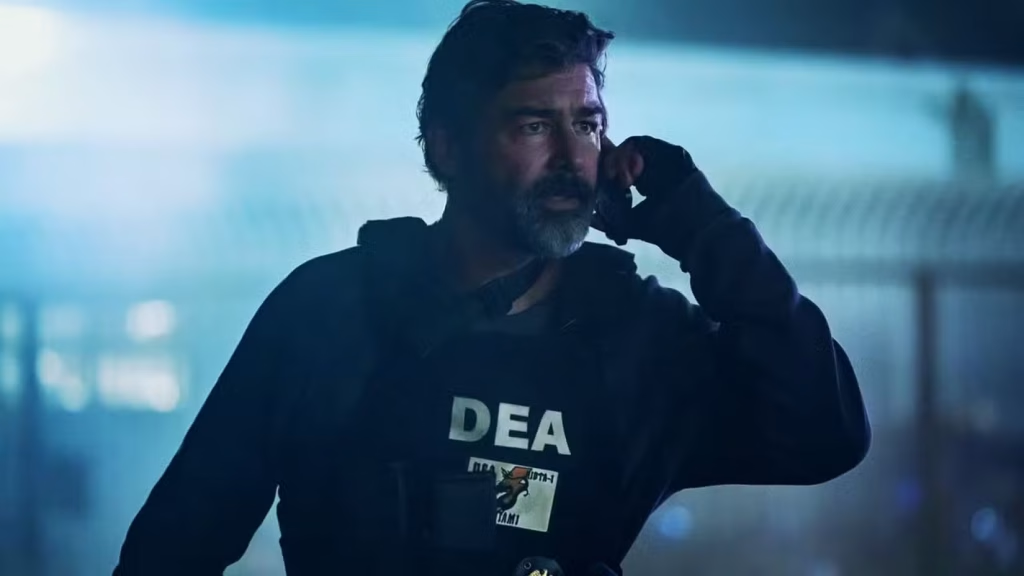
The Tactical Narcotics Team is stacked with personalities who feel like they’ve learned to work together by force of repetition: Detective Sgt. J.D. Byrne (Ben Affleck), Mike Ro (Steven Yeun), Numa Baptiste (Teyana Taylor), and Lolo Salazar (Catalina Sandino Moreno). They’re the kind of unit that survives on shorthand, on a sense that you know what the other person will do before they do it.
Dumars’ different-number lie cuts that cord.
Now each person has private information. Or thinks they do. And because the information is about money, every version of it comes with an emotional flavor. Twenty million feels different than five. “Enough to ruin your life” hits different than “enough to fix your life.”
The genius of the moment is that it makes everyone slightly lonely. Even when they’re standing shoulder to shoulder, they’re now holding separate realities in their heads.
The Lie Reveals the Movie’s Real Subject: Control
You can tell a lot about a character by what they do when everyone is watching. You can tell more by what they do when they can plausibly deny it later.
Dumars’ split answers are deniable. If called out, he can shrug and say he was estimating, that it was chaos, that people misheard. That’s the point. He’s testing what he can get away with in a room full of armed colleagues who are supposed to trust him with their backs.
This is why the moment rewrites the film. Suddenly, the central tension isn’t “Will someone steal the money?” It’s “Who is steering the suspicion, and why?”
Once you clock that, the rest of the stash-house sequence plays differently. Every instruction feels like a move. Every calming line sounds like a pressure point.
How It Reframes Byrne as More Than a Partner
Affleck’s J.D. Byrne is positioned as Dumars’ closest counterpart in the unit, the person who should be able to read him. They have the classic buddy-cop shorthand, the kind that makes you assume they’ll either go down together or drag each other back from the edge.
That assumption gets wobbly after the different-number moment.
Because now you’re watching Byrne watch Dumars. You’re not only tracking the external threats, like who else might learn about the cash and come knocking. You’re tracking the internal math: is Byrne being played, or is he playing too?
It’s a nasty little trick the movie pulls, and it’s effective. It turns familiar chemistry into a question mark without needing a melodramatic betrayal speech.
It Makes Later “Practical” Choices Look Suspicious

In a thriller like this, characters make a lot of decisions that can sound reasonable on paper. Keep the scene contained. Control the phones. Count the cash. Minimize leaks.
But once Dumars has shown he’ll manipulate information inside the team, all those practical choices take on a darker tint. When the unit locks down communication and tries to keep the situation in-house, you can’t help asking: is this procedure, or is this strategy?
That’s where The Rip gets most uncomfortable in a good way. It isn’t only about greed. It’s about who gets to define reality in a room full of people with guns and reputations and something to lose.
The stash house becomes less of a location and more of a pressure chamber. You can feel relationships compressing, then warping.
Why This Moment Hits Harder Than Any Gunfight
There are bigger scenes in The Rip. There are confrontations, spirals, and escalations. Critics and viewers have argued about how well the film sticks the landing, which is pretty normal for a contained thriller that eventually has to break containment.
But the small lie is the hinge.
It’s the moment where the movie stops being about money found in a house and starts being about people. About the way authority can hide behind competence. About how fast a team can become a set of suspects once the leader decides that suspicion is useful.
By the time you reach the later turns, you might realize the movie’s title isn’t only about ripping cash in a raid. It’s also about ripping trust, thread by thread, until the unit can’t recognize itself.

Rachel Sikkema is a New Zealand-based writer and creative entrepreneur who explores the intersection of film, culture, and modern relationships. Through her articles, she examines how stories shape the way we connect, love and see ourselves – all for God’s glory. When she’s not writing about film and television, she’s watching Dexter and The White Lotus for the third time.