If Avatar: Fire and Ash has a mission statement, it isn’t “bigger spectacle,” even though it delivers that too. It’s “stop treating the kids as emotional garnish.” The Sully children and Spider aren’t there to soften the war plot or sell toys. They’re the story’s pressure points, the places where every adult belief system starts to crack, contradict itself, or harden into something uglier.
That’s why the movie feels more argumentative than the previous chapters. The conflicts aren’t only humans versus Na’vi, or technology versus nature. The real friction shows up inside a family that’s grieving, improvising, and quietly rewriting its own rules in real time.
The Film Literally Shifts the Point of View to the Next Generation
One of the clearest signals comes from the narration. By letting Lo’ak (Britain Dalton) carry the voiceover instead of Jake (Sam Worthington), the film announces that the old “converted outsider” arc is no longer the center of gravity.
Jake is still crucial, but he’s no longer the audience’s main interpreter of Pandora. The interpreter is a teenager who’s still forming his moral instincts, still hungry for approval, and still capable of being wrong in interesting ways.
Lo’Ak Is Where Loyalty and Empathy Start Fighting Each Other
Lo’ak has always been the kid who runs toward trouble with his whole chest and then acts surprised when trouble runs back. In Fire and Ash, that impulsiveness becomes political. He’s the family member most likely to cross social borders, to bond with people his parents would rather avoid, and to interpret enemies as humans or Na’vi with reasons instead of monsters with targets.
That makes him a walking threat to any clean ideology. If the adults need a simple story to survive, Lo’ak keeps finding complicated people.
Kiri Turns Spirituality Into an Ethical Problem, Not a Comforting One
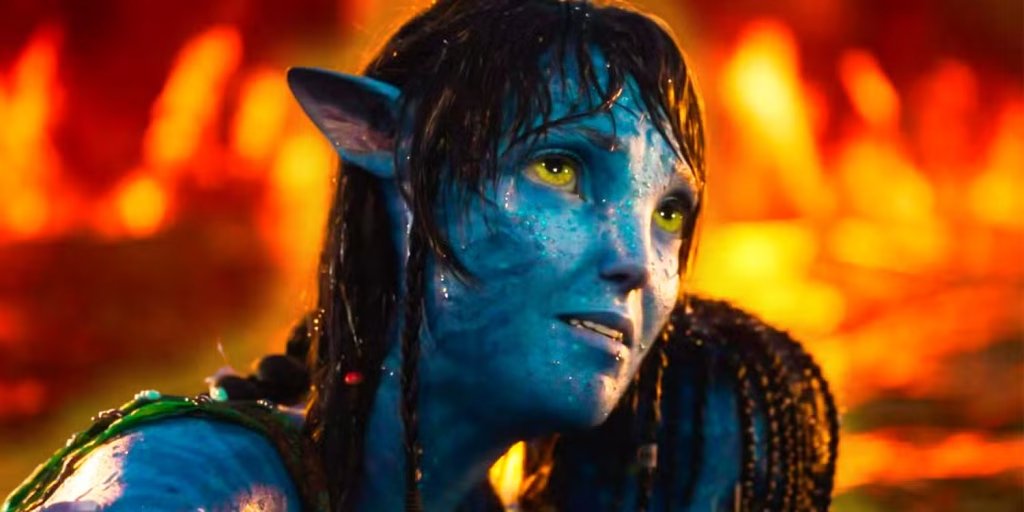
Kiri (Sigourney Weaver) has always been the series’ live wire: part mystery, part conduit, part quiet alarm bell for anyone who thinks Eywa behaves like a vending machine. In Fire and Ash, her connection to Pandora stops being purely awe-inspiring and starts feeling… consequential.
Kiri’s power changes the rules, which means her choices become moral arguments. When she acts, she’s not only helping her family. She’s also demonstrating what “nature” can do, what it will do, and what it might do again. That kind of power doesn’t stay private. It creates doctrine and fear. It creates imitation.
Spider Makes the Family’s Moral Rules Collapse in Real Time
Spider is the character who forces everyone to reveal what they actually believe, not what they say they believe.
Jake wants to be a principled leader, but Spider drags him into unbearable math: what do you do when love becomes a security risk? Neytiri (Zoe Saldaña) wants justice for what was taken from her, but Spider is the daily reminder that revenge can masquerade as righteousness. Even Kiri’s tenderness carries ideological weight, because it proposes a future where humans aren’t automatically outside the circle.
Spider isn’t a side character. He’s the referendum.
Tuk Carries the Cost of “Protecting Innocence” When Innocence Is Already Gone
Tuktirey “Tuk” (Trinity Jo-Li Bliss) is often treated, in big franchise storytelling, as the designated cuteness dispenser. Fire and Ash uses her differently. Tuk becomes the quiet indictment of every adult choice to escalate.
Because here’s the ugly truth: when the adults say “we’re doing this to protect the kids,” what they often mean is “we’re doing this and we hope the kids don’t notice what it does to them.” Tuk notices. She may not narrate it in speeches, but she holds it in her reactions, her fear, her bravery, and the way she watches her family’s rules change.
Neteyam’s Absence Becomes a Doctrine the Family Can’t Agree On
Neteyam (Jamie Flatters) doesn’t need screen time to shape the film. Grief is a belief system in Fire and Ash. Everyone turns Neteyam into a symbol, and symbols are always contested territory.
Jake can turn his son’s death into discipline. Neytiri can turn it into rage. Lo’ak can turn it into guilt, or into motivation, or into a lifelong argument with himself about who he’s allowed to become. Even Kiri’s spirituality reframes Neteyam, because memory in this world is never purely private.
Varang and the Ash People Show the Kids a Na’VI Worldview That Refuses the Old Binaries
The introduction of Varang (Oona Chaplin), the leader of the Mangkwan clan, also known as the Ash People, matters most for the children because she represents a future that’s legible, persuasive, and incompatible with the Sullys’ inherited story of harmony. Varang is not framed like a cartoon villain with a “bad tribe” label slapped on. She’s framed as force of will, culture, and grievance.
For the kids, this is the first time they’re confronted with a Na’vi ideology that doesn’t want their parents’ version of salvation. That confrontation is formative. It tells them that “being Na’vi” is not one moral position. It’s a spectrum, and sometimes a schism.
The Wind Traders Widen the Kids’ Map of What “Community” Can Look Like

The Wind Traders expand the social world in a way that naturally centers the kids. A trading culture is built on contact, compromise, and moving between groups. It’s the opposite of a fortress mindset.
Peylak (David Thewlis), their leader, is positioned as important not only in Fire and Ash but in the broader arc of the saga, which matters because kids like Lo’ak and Kiri are exactly the characters who will be shaped by a more fluid, interconnected Pandora.
Where This Leaves the Franchise
Fire and Ash treats the children as ideological fault lines because that’s where the franchise can evolve without losing its heart. Adults in these movies tend to speak in creeds: protect the clan, defend the planet, punish the invader. The kids speak in contradictions: I love you, I disagree, I’m scared, I’m curious, I’m loyal, I’m not sure.
That uncertainty isn’t weakness. It’s the only honest starting point for a world that’s changing. And if the next chapters land emotionally, it won’t be because the battles get louder. It’ll be because the children, forced to grow up inside history, decide what kind of people they’re willing to become.

Rachel Sikkema is a New Zealand-based writer and creative entrepreneur who explores the intersection of film, culture, and modern relationships. Through her articles, she examines how stories shape the way we connect, love and see ourselves – all for God’s glory. When she’s not writing about film and television, she’s watching Dexter and The White Lotus for the third time.