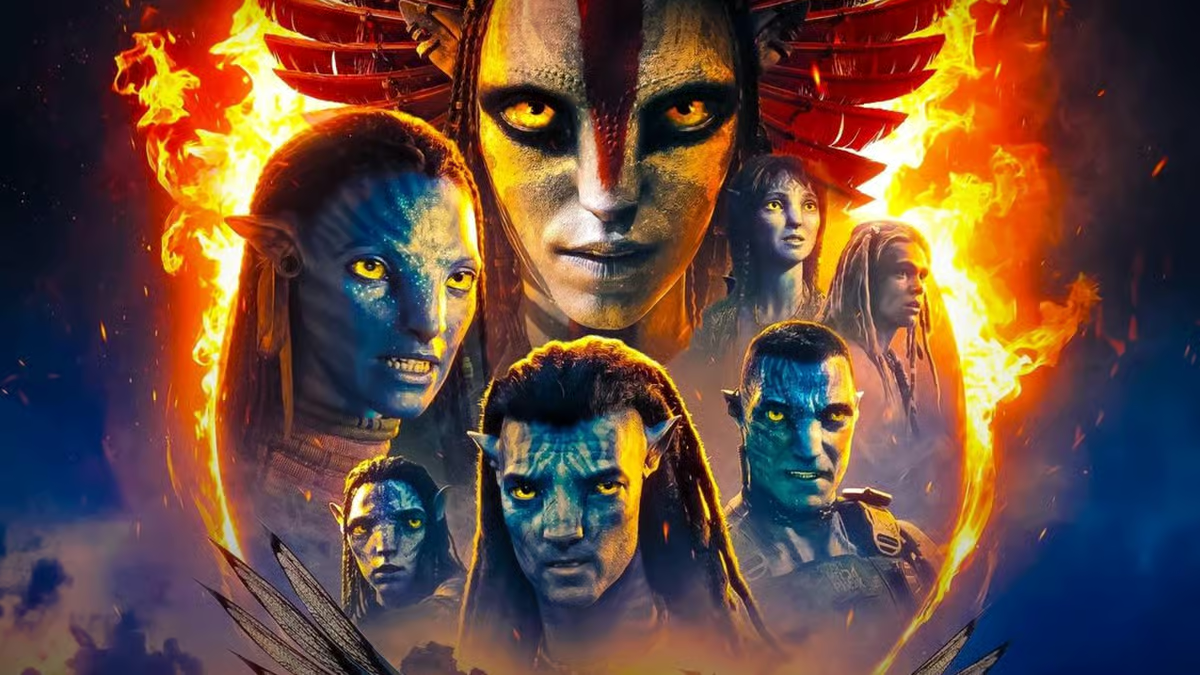
If the first Avatar movies made colonial violence feel obvious, Avatar: Fire and Ash makes it feel familiar. Not because the humans suddenly turn nice (they do not), but because the film starts asking the question resistance movements try to avoid: what happens after you win enough to matter?
James Cameron drops us back into Pandora with Jake Sully (Sam Worthington), Neytiri (Zoe Saldaña), and their family still carrying the grief of Neteyam’s death, and still living under the pressure of human colonization. The scale is massive, the runtime is massive (3 hours 15 minutes), and the emotional temperature runs hot enough to warp the moral geometry.
The title promises heat and aftermath. The movie delivers both.
Fire Is a Political Language in This Movie
Fire and Ash treats “fire” less like an element and more like a mindset. Cameron has talked about fire as hatred, anger, and violence, and ash as what follows: grief and loss. That framing matters because it turns the movie into a study of escalation.
In the earlier films, the Na’vi mostly function as a moral north star. Their communities argue, sure, but the story keeps pointing you toward a clean binary: living world versus extractive machine. Here, the binaries start to blur, and the film seems almost relieved about it. Pandora stays gorgeous, but politics always shows up the moment survival becomes strategy.
Resistance Needs a System, and Systems Start Making Demands
One of the smartest moves Fire and Ash makes is shifting the feeling of the conflict. This time, it isn’t only “How do we stop the invader?” It’s “What do we become while we’re stopping them?”
Jake is still a soldier at heart. He plans, he calculates, he tries to keep his kids alive by controlling the variables. That sounds reasonable until you remember the fine print: control is basically the seed of empire. Even when it starts as protection, it can turn into policing.
Varang and the Ash People Are Not “Evil Na’VI,” and That’s the Point

The new antagonist Varang (Oona Chaplin), leader of the Mangkwan clan, arrives like a slap across the franchise’s usual moral comfort. Varang’s people, often described as the Ash People, carry the visual vocabulary of intimidation: heat, soot, severity. But the film isn’t satisfied with “new tribe bad.” It frames them as a culture shaped by catastrophe, distrust, and a worldview where mercy reads as weakness.
Some coverage around the film has described the Mangkwan turning away from Eywa after a volcanic disaster shattered their home. Whether you read that literally or spiritually, the takeaway is the same: trauma can rewrite theology, and theology can rewrite politics.
The movie doesn’t ask you to like them. It asks you to recognize the shape of the logic.
Neytiri’s Grief Turns Into Policy
Zoe Saldaña gives Neytiri an edge that the earlier films mostly kept sheathed. Her grief curdles into something sharper, and the movie lets that ugliness sit in the light. In interviews around the film, the creative team has been blunt about Neytiri’s hatred toward the Sky People, especially as it focuses on Spider (Jack Champion).
That focus is key. Bigotry in stories often gets treated as a personality flaw you solve with a heartfelt speech. Fire and Ash treats it like politics. Neytiri’s hatred isn’t a private emotion when she’s a leader, a mother, and a symbol. It becomes a force that shapes what the family can tolerate and what their community can justify.
The Wind Traders Show How Wars Recruit Everyone
The franchise has always understood that “neutral” usually means “next.” Fire and Ash makes that explicit through the Wind Traders and their leader Peylak (David Thewlis), a Na’vi figure tied to movement, trade, and the politics of passage. Cameron has described the Wind Traders as Na’vi who aren’t place-specific, which already puts them in a different political category from clans rooted to a single homeland.
Mobility sounds like freedom until you realize it also makes you a prize. Everyone wants the people who can move goods, information, and bodies. Everyone wants the routes. Everyone wants the ships.
Quaritch Thrives When the Oppressed Start Arguing About Who Counts

Colonel Miles Quaritch (Stephen Lang) stays the franchise’s blunt instrument, but Fire and Ash uses him more like a wedge. Empire doesn’t only conquer with weapons. It conquers by making the occupied fight over legitimacy: who is pure, who is compromised, who is “one of us,” who is a problem you can justify removing.
Quaritch benefits from every fracture, including the ones the Na’vi create themselves. The film’s tension around Spider, around intermixing, around strategy versus spirit, all of it becomes terrain. This is one reason the “resistance becomes empire” idea lands: the moment a movement starts treating internal dissent as contamination, it starts doing empire’s job for it.
The scariest part is how understandable the temptation feels. Fear makes hard boundaries feel like safety. The movie keeps showing the cost.
The Movie Wants You Uneasy, and It Earns It
A lot of blockbusters confuse “dark” with “serious.” Fire and Ash goes for something trickier: discomfort. It keeps asking whether the fight for survival can twist into the desire to dominate, and whether anyone notices the moment the line gets crossed.
It also refuses to pretend that grief stays private. Grief becomes doctrine. Anger becomes strategy. Trauma becomes architecture. The politics get uncomfortable because the emotions are believable, and because the film understands a hard truth: when people feel cornered, they reach for power. Even good people. Even wounded people. Especially wounded people.
That doesn’t make the Na’vi equivalent to the colonizers. The movie is not playing that cheap “both sides” game. It’s doing something sharper. It’s warning that liberation can inherit the tools of conquest if nobody interrogates what “winning” starts to mean.

Rachel Sikkema is a New Zealand-based writer and creative entrepreneur who explores the intersection of film, culture, and modern relationships. Through her articles, she examines how stories shape the way we connect, love and see ourselves – all for God’s glory. When she’s not writing about film and television, she’s watching Dexter and The White Lotus for the third time.