After two films of lush beauty and very loud, very clear villains, Avatar: Fire and Ash makes a riskier move. It stops treating Pandora like a moral reset button where the Na’vi are always right, the humans are always wrong, and the audience can relax into righteousness. Instead, it asks the more annoying question: what happens when a world you love still contains people who can be selfish, cruel, or desperate?
That shift matters because it turns Pandora from a symbol into a society. And once a place feels like a society, the conflicts stop being tidy. Grief hardens people. Faith gets weaponized. Survival turns into justification. Suddenly “good” and “evil” start looking less like teams and more like choices.
Grief Changes the Rules
The film picks up in the shadow of loss, with Jake Sully (Sam Worthington) and Neytiri (Zoe Saldaña) still carrying the weight of what happened to their family in The Way of Water. It’s not background emotion either. It becomes the engine that pushes characters into decisions they might have judged in a calmer year.
Grief is also where the movie starts widening its moral lens. When people hurt, they don’t always become wiser. Sometimes they become sharper, quicker to assume intent, quicker to punish. Fire and Ash treats that as tragic, but also believable. It’s the kind of mess that makes a world feel lived-in instead of curated.
The Ash People Make the Na’VI Harder to Idealize
The big new complication is the Ash People, also called the Mangkwan clan, led by Varang (Oona Chaplin). The point is not “look, evil Na’vi.” The point is that hardship can produce its own ideology, and ideology can turn into permission. Varang’s worldview comes out of devastation and survival, and the film doesn’t pretend that origin story magically makes her methods noble.
James Cameron has been open about wanting to move beyond the earlier setup where humans skew negative and Na’vi skew positive. That intention is all over the screenplay’s shape: the Ash People aren’t a random twist, they’re a structural rebuttal to the franchise’s original moral simplicity.
The Wind Traders Add a Third Option That Isn’t “Surrender”

If the Ash People complicate the Na’vi from the “dark” side, the Wind Traders complicate the whole conflict from a different angle. Led by Peylak (David Thewlis), they aren’t there to be saints or villains. They’re there to be a reminder that not every community wants to become a soldier in someone else’s war.
That might sound like cowardice in a more simplistic blockbuster, but the film treats it as politics. Neutrality can be survival. Trade can be diplomacy. And choosing not to worship the same priorities as the Sully family doesn’t automatically make a clan immoral. It just makes the world bigger than Jake’s personal story.
Quaritch Becomes a Pressure Test, Not a Cartoon
Colonel Miles Quaritch (Stephen Lang) still brings menace, but the film uses him less like a pure embodiment of evil and more like a problem that changes depending on who tries to solve it. His connection to Spider (Jack Champion) keeps pulling the story into uncomfortable emotional territory, where hate and attachment can coexist without canceling each other out.
That matters for the movie’s moral expansion because it refuses to let you file characters into permanent categories. The film keeps showing how people rationalize their actions in real time, not in hindsight. Quaritch can commit atrocities and still crave a bond. Spider can love someone dangerous and still know better.
Humans Get Faces, and the Franchise Stops Arguing With a Straw Man
One of the franchise’s long-running critiques has been that the human side often functions like a single, faceless machine: greed, guns, bulldozers, repeat. Fire and Ash doesn’t pretend the colonizing force suddenly becomes ethical, but it does sharpen the internal contrast. Cameron’s stated goal of flipping the earlier “humans bad, Na’vi good” emphasis shows up in the way individual humans are framed as capable of choices, not only programming.
That shift is subtle but important. When your villain faction becomes a monolith, the moral argument gets lazy. When you give the audience specific humans with competing motives and limits, you force the story to argue with real behavior instead of a symbol.
Fire and Ash Are Not Gimmicks, They’re the Movie’s Thesis
The title is doing thematic work. The film treats fire as more than spectacle. It’s anger, ideology, the thrill of cleansing something you’ve decided is contaminated. Ash is what’s left after the thrill. It’s grief, consequence, the dull residue of “winning.” That symbolism is explicitly tied to the movie’s emotional arc, not just its new visual palette.
What I liked is that the movie doesn’t romanticize suffering as spiritual proof. Pain doesn’t automatically make you wise. Loss doesn’t automatically make you pure. Sometimes it makes you petty. Sometimes it makes you cruel. And sometimes it makes you cling harder to whatever story lets you keep moving.
Pandora Feels Less Like a Sermon and More Like a World
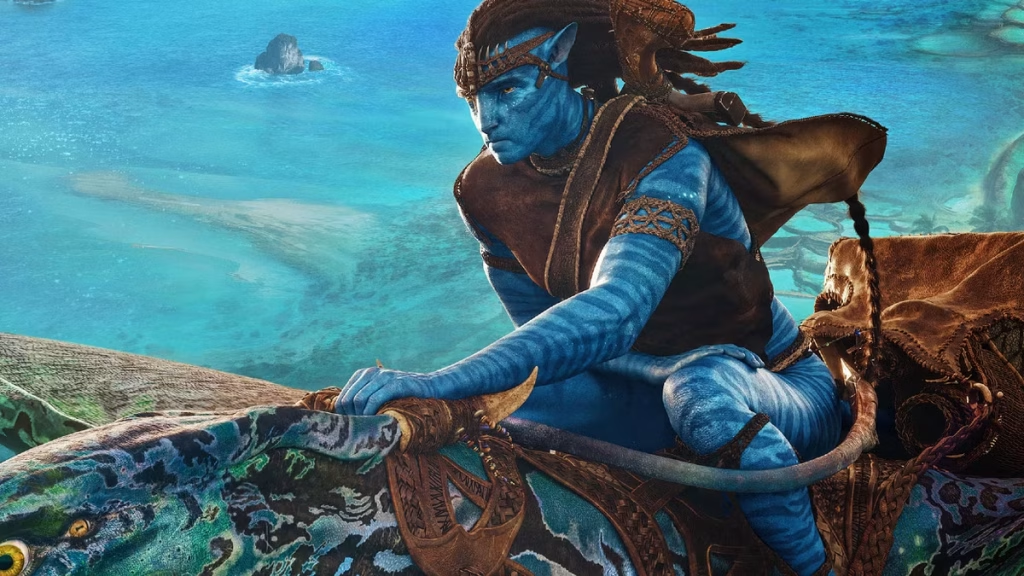
The biggest upgrade here is that Pandora starts to feel morally crowded. You get clans with different beliefs, different survival strategies, and different thresholds for violence. You get humans who aren’t all identical in motive, even when they’re complicit in the same machine. And you get a central family whose love is real, but whose choices can still be flawed.
That combination is what pushes Fire and Ash beyond a clean parable. It’s still emotional, still huge, still engineered for awe, but it’s also willing to admit that “us versus them” is a story people tell when they’re scared. Pandora doesn’t need that story anymore. It’s grown past it, and the franchise is finally catching up.

Rachel Sikkema is a New Zealand-based writer and creative entrepreneur who explores the intersection of film, culture, and modern relationships. Through her articles, she examines how stories shape the way we connect, love and see ourselves – all for God’s glory. When she’s not writing about film and television, she’s watching Dexter and The White Lotus for the third time.