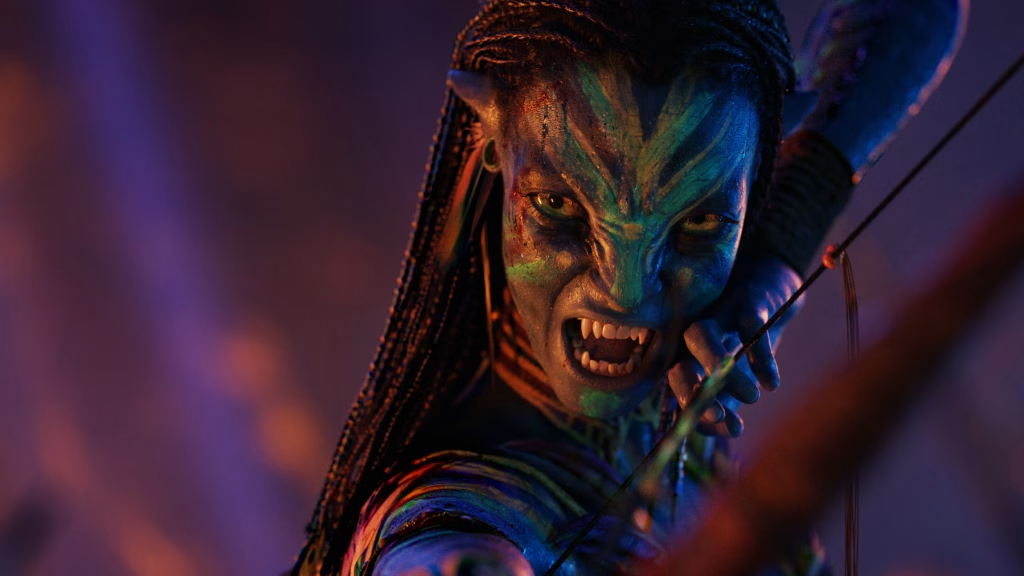
There’s a kind of comfort we reach for in big, righteous stories: the idea that the people fighting back are cleanly good, spiritually aligned, morally tidy. Their cause is pure, their violence is regrettable but necessary, and their leaders never get tempted by uglier instincts. The Avatar saga has always flirted with that comfort on purpose, because it’s powerful, and because it looks gorgeous in blue.
Avatar: Fire and Ash takes a sharp turn by poking at the fantasy that revolutions come with a certified ethical label. It asks a question revolutionary stories often dodge: what happens when the people you root for stop behaving in ways that make you feel virtuous for rooting?
Purity Makes a Revolution Easier to Sell
Revolutionary storytelling loves a clean contrast. It gives you a machine with a logo on it and a culture with a heartbeat, then dares you to pick a side. James Cameron built Pandora as a place where your moral compass feels almost automatic, because the world is literally wired for connection and reciprocity.
But purity is also a marketing tool inside stories. It keeps the audience calm and the heroes legible. It keeps you from having to look too closely at the messy parts, like factional politics, revenge cycles, and what grief does when it stops being private.
The Ash People Exist to Ruin Your Clean Moral Map
The Mangkwan, also called the Ash People, arrive as a blunt narrative interruption. They are Na’vi, they’re indigenous to Pandora, and they don’t behave like the franchise’s comfort-food version of spiritual harmony. Their leader, Varang (Oona Chaplin), isn’t framed as a cartoon villain so much as a leader forged by catastrophe who has decided tenderness is a luxury she can’t afford.
That matters because revolutionary stories often treat “the oppressed” as a single moral unit. The Ash People blow that up. They make it harder to use identity as a shortcut to innocence. They also create a more honest kind of tension: not “good people versus bad people,” but “wounded people with different answers about what survival requires.”
When Grief Turns Into Doctrine, It Stops Being Sympathetic
The most unsettling revolutions are the ones that turn pain into a religion. Varang’s backstory, as described in cast and character material around the film, hinges on devastation in her environment, the kind that can shatter not only homes but faith. The result isn’t “evil.” It’s a worldview where anger feels like clarity and mercy looks like betrayal.
That is exactly where the illusion of purity starts to crack. Revolutionary narratives love to sanctify grief, because grief is real and grief is persuasive. But grief can also become a tool. It can become a recruiting poster. It can become an excuse for cruelty that still feels righteous to the people committing it.
Neytiri’s Pain Complicates the Hero Story in the Best Way

If The Way of Water was about survival, Fire and Ash sounds like it’s about what survival costs you emotionally. Jake Sully (Sam Worthington) has always been a warrior with a conscience, but he also has a soldier’s instinct to reduce chaos into objectives. Neytiri (Zoe Saldaña) has always been the heart of the saga’s moral clarity, the character who makes the audience feel Pandora’s values in their bones.
Now she’s a mother living with a kind of loss that doesn’t politely resolve. The grief after Neteyam’s death hangs over this chapter, and the franchise seems willing to let that grief be ugly, not inspirational. The most telling thing floating around the film’s discourse is a line attributed to Jake pleading that they can’t live with that much hate. That isn’t a villain speech. That’s a marriage speech.
Quaritch and Spider Make Purity Impossible
Colonel Miles Quaritch (Stephen Lang) continues as the franchise’s great irritant: the character you want to hate cleanly, but who keeps dragging the story into emotional gray zones. His connection to Spider (Jack Champion) ensures the conflict never stays purely symbolic. Families don’t fit neatly into slogans. Neither do children, especially children stuck between identities and loyalties.
Revolutionary stories often simplify the enemy so the audience can enjoy the resistance without guilt. Spider breaks that dynamic. He forces a question the saga keeps circling: what do you do with the people who are shaped by the invader but don’t fully belong to them? If you demand purity, you reject them. If you accept complexity, you risk being hurt.
Eywa Can Be a Comfort, or a Weapon, Depending on Who’s Speaking
Kiri (Sigourney Weaver), with her intense connection to Eywa, sits right at the center of the franchise’s spiritual mythology. She represents the idea that this world has meaning, that connection is real, that the planet’s intelligence isn’t a metaphor.
Varang represents the opposite impulse: the moment someone looks at that same spiritual system and says it failed them. If you want a revolution to feel pure, you need a god who endorses it. If you want to justify brutality, you can claim the god is absent, or that you’ve replaced the god with something stronger.
This Is How the Saga Grows up Without Turning Cynical

The best version of this theme doesn’t flatten anyone into monsters. It doesn’t treat the Ash People as proof that “everyone is equally bad,” because that’s a lazy kind of maturity. Real complexity doesn’t mean abandoning moral judgment. It means earning it.
The franchise can still be anti-colonial while admitting that resistance movements fracture, leaders manipulate, and trauma reshapes values. In fact, that honesty can make the anti-colonial spine stronger, because it stops relying on a fantasy of saintly victims.
If Fire and Ash lands this, it won’t feel like a betrayal of the series’ heart. It will feel like the story finally trusts the audience enough to handle the truth: revolutions are rarely pure, and the people inside them still deserve to be seen clearly.

Rachel Sikkema is a New Zealand-based writer and creative entrepreneur who explores the intersection of film, culture, and modern relationships. Through her articles, she examines how stories shape the way we connect, love and see ourselves – all for God’s glory. When she’s not writing about film and television, she’s watching Dexter and The White Lotus for the third time.