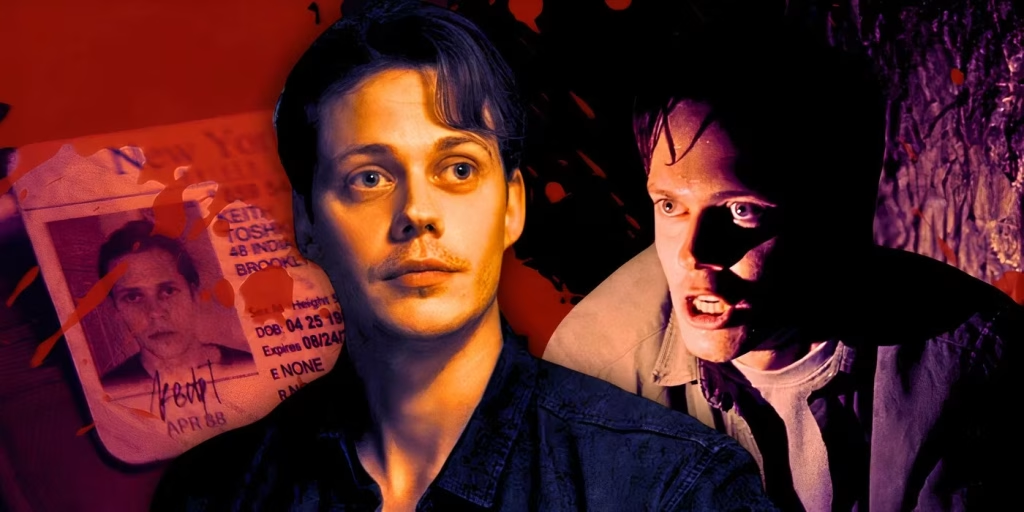
Bill Skarsgård has one of those faces horror directors must dream about and fear a little. It can look handsome, haunted, unreadable, sweet, or deeply wrong depending on the angle. A smile from him can feel like a flirtation or a warning. Sometimes both.
That is exactly why his casting in Barbarian works so beautifully.
The first stretch of Zach Cregger’s film depends on the audience watching Skarsgård as Keith and quietly interrogating every single thing he does. He has rented the same Detroit house as Tess, played by Georgina Campbell, and he appears to be the nightmare scenario before the movie has technically done anything horrifying. A strange man. A dark rental. A double booking. Bad weather. No easy exit.
Then the film just lets him stand there, being Bill Skarsgård.
It is such a simple trick that it almost feels rude. We bring the baggage for the movie. Barbarian barely has to lift a finger.
Keith Seems Suspicious Because We Expect Him to Be
Skarsgård’s presence arrives preloaded with dread. After It, he can barely enter a horror movie without viewers bracing themselves for a hidden set of teeth. Pennywise turned his face into a genre object. That smile, that careful stillness, that sense of private amusement behind the eyes. Even when he plays normal, some part of the audience waits for the mask to slip.
Barbarian knows that and has a little fun with it.
Keith does many things that should be considered reasonable. He offers Tess the bedroom. He shows her the booking confirmation. He tries to be polite without forcing intimacy too quickly. He makes tea and finds a bottle of wine. He tries to lower the temperature in the room, socially speaking, because any normal person would understand how bad this looks.
And yet every gesture feels loaded because Skarsgård is the one making it.
When Keith laughs softly, the laugh feels rehearsed. When he explains himself, the explanation sounds a touch too clean. When he insists Tess should stay rather than wander into the night, the advice makes practical sense and still lands like a trap clicking shut.
The beauty of the performance is that Skarsgård never overplays the ambiguity. He does not leer. He does not hover in the hallway like a villain trying to get caught early. He lets Keith be slightly awkward, a little too eager to prove he is harmless, and maybe genuinely embarrassed by the whole mess.
That is more unnerving than a darker performance would have been.
Tess Reads the Room Better Than Most Horror Characters
A huge part of why this works comes from Georgina Campbell. Tess has the kind of alertness horror movies often pretend their heroines have, then ignore as soon as the plot needs them to do something foolish. Campbell plays her as observant from the first minute. She clocks details. She pauses before stepping inside. She keeps reassessing the situation.
Her suspicion of Keith feels social and physical, not just plot-required.
That makes the casting even sharper. Tess has no idea she is standing across from the guy who played Pennywise. We do. So the movie creates two layers of fear at once. Tess is responding to the realistic danger of being alone with a stranger. The audience is responding to that and to the genre memory Skarsgård carries with him.
It is a nasty little double exposure.
The scenes between Tess and Keith keep shifting in tiny ways. For a few seconds, he seems charming. Then he says something with a bit too much intensity. Then he backs off. Then he seems genuinely thoughtful. Then the camera holds a moment longer than comfort allows.
The movie turns basic politeness into a pressure system.
Even the wine scene has that itchy quality. Keith refuses to open the bottle before Tess sees it sealed, which is exactly the sort of considerate move that should earn trust. Somehow, because of the setup and because of Skarsgård’s strange calm, it almost makes him seem more suspicious. Like he studied how a safe man behaves.
That is the trick. The correct move and the creepy move occupy the same space.
The Movie Weaponizes Horror Casting Memory

Horror has always loved using actor baggage. Janet Leigh walking into Psycho meant something. Drew Barrymore answering the phone in Scream meant something. More recently, audiences have learned to scan every famous face in a genre movie for a clue. Casting becomes part of the grammar.
Barbarian uses Skarsgård’s horror image as a decoy.
The film does not need to make Keith obviously dangerous, because the audience has already supplied that possibility. His casting creates a phantom version of the movie where the story is about a woman trapped with a charming predator in an Airbnb. Honestly, that version would probably work too. The opening is tense enough to sustain a smaller thriller.
But Cregger has something stranger in mind.
The best misdirects feel obvious only after they happen. Keith’s function is to make the viewer look in the wrong corner of the room. We are trained to watch his hands, his tone, his smile. We are primed to treat the house as dangerous because he is in it.
Meanwhile, the real horror waits below.
That shift works because the first act commits so fully to Keith as a question mark. The movie understands that the basement door does not need to be the first thing we fear. In fact, it becomes scarier because Tess and the audience have spent so much energy measuring the man upstairs.
Skarsgård gives the film a human red herring with a pulse.
Keith’s Normalness Becomes the Surprise
The more time Tess spends with Keith, the more the movie allows a possibility that feels almost suspicious in itself. Maybe he really is just a guy. Maybe he is awkward because the situation is awkward. Maybe his attempts at reassurance sound strange because any attempt at reassurance would sound strange in that house.
That is where Skarsgård’s performance gets sneakily tender.
Keith has a nervous softness to him. He seems like someone who wants to be liked and knows wanting that too visibly can make things worse. His posture sometimes has a folded quality, as if he is trying to make himself smaller in a room where his presence is automatically a threat.
There is a very funny sadness in that. He can do everything right and still look like the wrong man.
The movie’s treatment of him grows almost perverse because the audience’s suspicion starts to curdle into guilt. We have been judging him before he has done much of anything. Tess has good reason to be cautious, of course. The film never mocks her caution. It respects it. But as viewers, we also recognize how eagerly we accepted Keith as a possible monster.
Then Barbarian pulls the floor out.
Keith’s fate has such a blunt, horrible speed that it scrambles the movie’s rules. The threat we were watching has been watching the wrong thing too. His confusion feels real. His fear feels real. For a moment, he becomes exactly what Tess was in the opening stretch, a person caught in a situation his brain cannot organize quickly enough.
Skarsgård’s casting makes that turn nastier. The face we expected to reveal evil instead reveals panic.
Justin Long’s Arrival Makes the Trick Even Sharper
The movie’s second major casting move works in a different register. Justin Long’s AJ arrives with a completely separate energy, all self-pity, entitlement, and sweaty denial. Where Keith triggers danger because he seems unknowable, AJ becomes alarming because he is painfully recognizable.
That contrast makes Skarsgård’s role look even smarter in hindsight.
Keith is the man the audience suspects. AJ is the man the movie wants us to study. He is not framed like a shadowy horror figure. He is framed like a guy who keeps talking himself into being the victim of his own behavior. Long gives him a slippery comic rhythm that makes him horribly watchable. Every rationalization lands with that little sting of recognition.
By the time AJ enters the house, the audience has already been trained badly by Keith. We learned that our first suspicion could be misplaced. So when AJ starts making choices that reveal his character, the film has us in a different kind of tension. We stop looking for the hidden monster and start noticing the obvious rot.
That is one reason Barbarian has stuck around in people’s heads. It has more on its mind than the basement. The movie keeps asking who gets read as dangerous, who gets the benefit of the doubt, and how quickly people explain away harm when it serves them.
Skarsgård’s Keith is central to that machinery. He is the false alarm that tunes the whole instrument.
The Scare Works Because the Casting Is So Precise
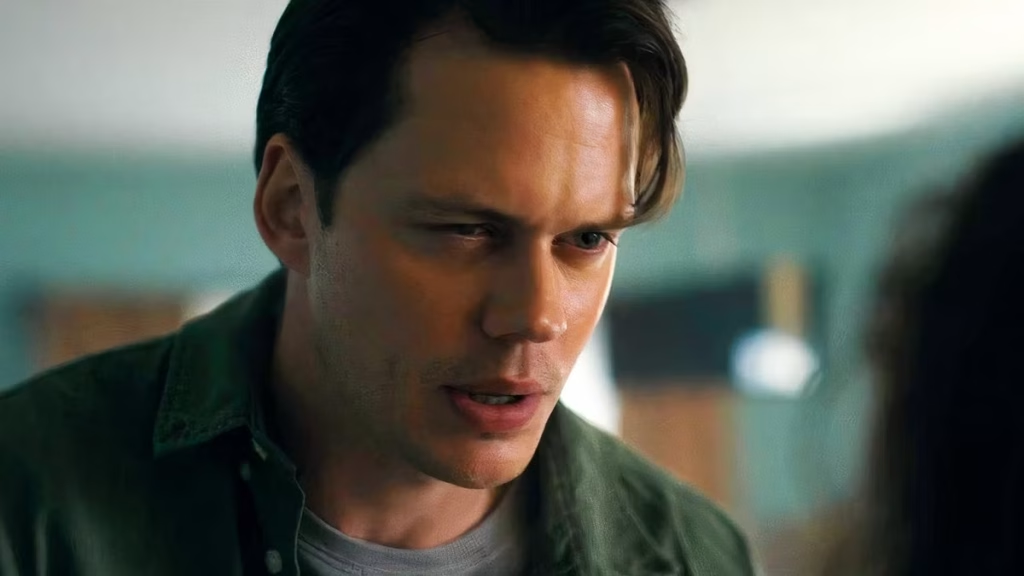
A lesser version of Barbarian would cast Keith as blandly handsome and let the situation do all the work. A more obvious version would make him visibly creepy from the start. Skarsgård gives the movie a more interesting middle path. He is inviting and unsettling in the same breath.
That is a rare quality.
He understands how to hold back just enough. The performance never begs the viewer to suspect him. It simply leaves space for suspicion to grow. The camera can sit on his face and let the audience do the ugly little math.
That makes the eventual reveal feel less like a twist for twist’s sake and more like a joke played on our viewing habits. We thought we knew what kind of horror movie we had rented for the night. We saw Bill Skarsgård in the doorway and started writing the story ourselves.
Barbarian lets us write it wrong.
That may be the film’s sneakiest pleasure. It turns one actor’s horror legacy into a trapdoor. Skarsgård walks in carrying Pennywise’s shadow, then uses it to hide a very human, very doomed man in plain sight. The movie scares us with what we think we know about him.
Then it shows us how little that helped.

Rachel Sikkema is a New Zealand-based writer and creative entrepreneur who explores the intersection of film, culture, and modern relationships. Through her articles, she examines how stories shape the way we connect, love and see ourselves – all for God’s glory. When she’s not writing about film and television, she’s watching Dexter and The White Lotus for the third time.