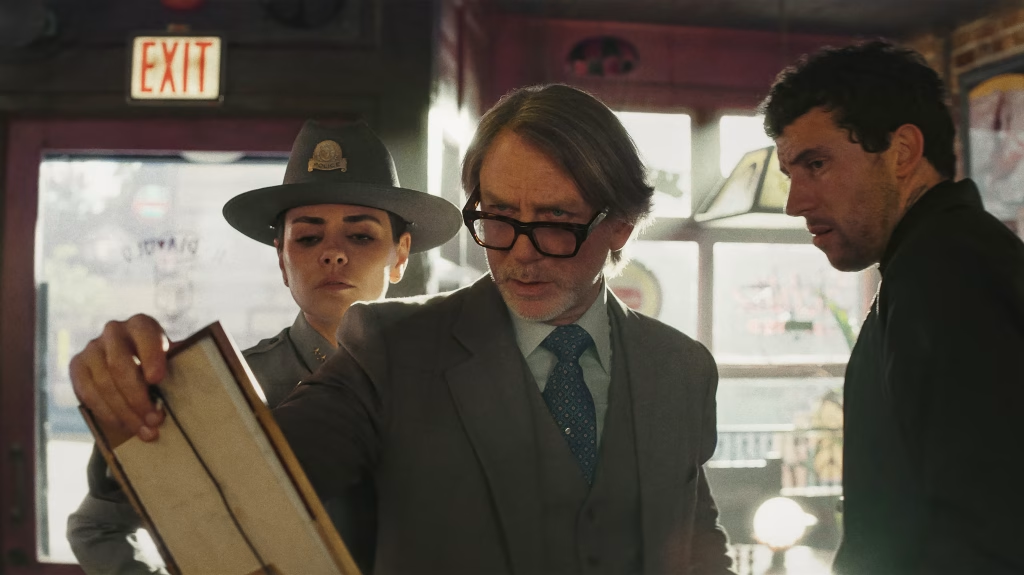
Benoit Blanc has always walked into a room like a man carrying two things at once: a magnifying glass and a sermon. He smiles, he listens, he plays the polite Southern gentleman, and then he quietly pulls the floorboards up. So when Wake Up Dead Man: A Knives Out Mystery drops him into a church-shaped pressure cooker, it’s fair to wonder if he’s crossed a line. Is Blanc still solving crimes, or is he grading souls?
Benoit Blanc Was Never a Neutral “Clue Guy”
If you picture a classic mystery detective as a human calculator, Blanc has never fit the job description. Even in Knives Out, the pleasure wasn’t simply watching him identify the murderer. It was watching him identify the lie everyone agreed to live inside.
That’s the trick with Blanc. He doesn’t only ask “who did it?” He asks, “What were you willing to overlook because it benefited you?” That question lands like moral judgment, even when it’s delivered with a courteous little drawl and a pocket square.
The Series Keeps Shifting From Puzzles to Values
Rian Johnson has treated each Benoit Blanc movie like a new dinner party with a different kind of rot under the tablecloth. The tone changes, the setting changes, and the targets change, but the real game stays consistent: expose the stories people tell to protect power.
Glass Onion made that theme loud and glossy, then cruelly simple. Wake Up Dead Man pivots again, swapping sunlit spectacle for something closer to Gothic dread. In the official framing, Blanc leaves Greece and heads to a small upstate New York hamlet for “a whodunnit of biblical proportions.” That wording matters. “Biblical” isn’t just vibes. It signals that the movie wants you thinking about sin, belief, loyalty, punishment, and grace.
A Church Case Makes Everyone Talk Like They’re Innocent
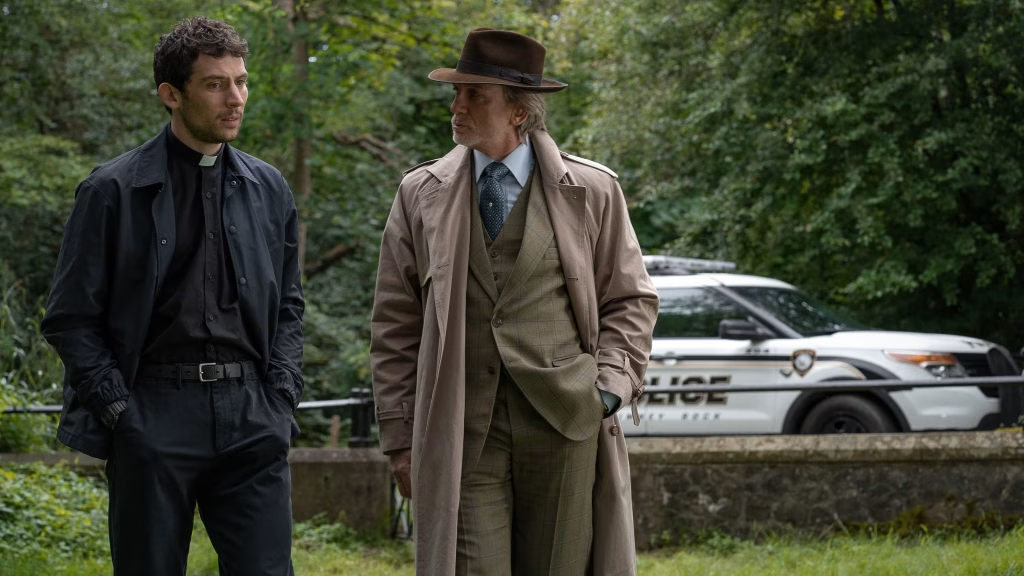
A church setting changes the temperature of a mystery immediately. People don’t only hide secrets in a church. They hide justifications. They hide behind language like redemption, temptation, and forgiveness. They weaponize virtue. They call their fear “principle.”
That’s the kind of environment where a detective can start to sound like a moral judge without trying. If Blanc says, “You lied,” it’s never only about facts. In a church, “You lied” echoes as “You sinned.” The room does the moralizing for him.
In Wake Up Dead Man, Blanc gets pulled into an “impossible crime” tied to a local church called Our Lady of Perpetual Fortitude, with Mila Kunis playing police chief Geraldine Scott, the one who taps him for the case. Put that detail under a microscope and you can see the movie’s agenda. The institution that’s supposed to represent moral order becomes the site of chaos. That tension forces every character to declare what they believe, and what they’ll do to protect it.
Detecting and Judging Look Similar When the Truth Hurts
Here’s the uncomfortable reality: a great detective often functions like a judge because the reveal creates consequences. When Blanc names the killer, he also names the enabling. He names the cowardice. He names the cruelty that was hiding under politeness.
That can feel like judgment, especially because Blanc’s “big moment” usually arrives with theatrical clarity. He doesn’t just explain the mechanics. He frames the behavior. He makes the lie sound small, and he makes the choice sound deliberate. The culprit loses more than freedom. They lose their self-image.
But there’s a difference between moral judgment and moral clarity. Blanc doesn’t present himself as spiritually superior. He presents himself as allergic to bullshit. He’s less a judge on a bench and more a man switching on the fluorescent lights in a messy kitchen.
The New Cast Helps Turn the Knife
Ensemble mysteries live or die on whether every character feels like they’re hiding something specific, not just “a secret.” Wake Up Dead Man stacks the deck with actors who can play charm and menace in the same breath: Daniel Craig returns as Blanc alongside Josh O’Connor, Glenn Close, Josh Brolin, Kerry Washington, Andrew Scott, Jeremy Renner, Cailee Spaeny, Daryl McCormack, and Thomas Haden Church.
When you cast Glenn Close, you’re basically inviting moral intensity to the party. When you cast Josh Brolin as Monsignor Jefferson Wicks, described as a firebrand who “rules with an iron fist,” you’re signaling that authority will be part of the mystery’s power struggle. And when you build the story around a priest (O’Connor) as the character with the deepest personal stakes, you’re telling the audience to watch faith, guilt, and loyalty as closely as fingerprints.
Even the jokes push in that direction. Johnson has mentioned slipping in a pointed gag about how everyone thinks they’re the heroic side of history. That idea is funny, sure, but it’s also moral framing. It’s the movie winking while it quietly asks: are you actually the good guy, or do you just like the costume?
So Is Blanc a Moral Judge Now?

He’s becoming something slightly weirder, and more interesting: a detective whose work exposes moral math. He doesn’t hand down sentences. He reveals what people were willing to do, and then he lets the room react. In a church mystery, that reaction comes with extra weight, because the setting trains everyone to think in terms of virtue and punishment.
If Blanc feels more judgmental in Wake Up Dead Man, it’s because the series has sharpened its focus. The mysteries increasingly care less about cleverness for its own sake and more about the social and spiritual fallout of deception. Blanc is still solving the case. He’s also measuring the cost of the lie.
That’s why he doesn’t feel like he’s turning into a moral judge so much as he’s turning into a moral mirror. He shows characters who they are when nobody’s watching, and then he makes them watch anyway.

Rachel Sikkema is a New Zealand-based writer and creative entrepreneur who explores the intersection of film, culture, and modern relationships. Through her articles, she examines how stories shape the way we connect, love and see ourselves – all for God’s glory. When she’s not writing about film and television, she’s watching Dexter and The White Lotus for the third time.