Tess Marshall does something rare in modern horror. She thinks like a real person, then keeps thinking after the movie starts punishing her for it.
That sounds simple, but Barbarian gets a lot of power from watching Georgina Campbell play Tess as someone whose intelligence lives in tiny choices. The pause before she steps inside. The careful scan of a room. The way she tries to soften awkwardness without giving away too much of herself. She has the exhausting social awareness of a woman who has spent her life measuring the temperature of men she barely knows.
A lot of horror heroines get called smart because they fight well or figure out the twist early. Tess is smarter than that. Her brain works before the danger has a name.
The genius of Zach Cregger’s film is that Tess is trapped by two opposite truths. Her caution is correct, and her compassion is also correct. The nightmare comes from the fact that both instincts keep dragging her deeper.
Tess Knows the Airbnb Is Wrong Right Away
The opening of Barbarian is such a nasty little pressure cooker because Tess clocks the problem immediately. She arrives late at night, in the rain, in a neighborhood that already feels hollowed out and unfriendly. The rental key is missing. The house is double-booked. A strange man is inside.
Keith, played by Bill Skarsgard, does plenty to seem harmless. He is polite. He is awkward. He is almost too eager to prove that he understands why the situation looks bad. That casting is a dirty trick, of course. Skarsgard carries so much horror baggage from It that the audience is trained to distrust him before he has done anything.
Tess distrusts him too, but she does it with manners. That is where the scene gets painfully accurate.
She takes a photo of his ID. She refuses the open bottle of wine. She makes him open his drink first. She keeps the bedroom door locked. She watches his reactions. These choices never feel like screenwriter cleverness. They feel like a woman trying to survive a socially delicate situation without escalating it.
That is a very specific kind of intelligence, and horror rarely gives it this much room. Tess understands that danger can come from a man being violent, but it can also come from a man feeling insulted, embarrassed, or rejected. She has to protect herself while managing Keith’s ego, even though he appears to be decent.
That double labor is the whole first act.
Her Politeness Gets Mistaken for Weakness
One of the best things about Tess is that she has a soft voice without being weak. Campbell plays her with warmth, but there is a steady spine underneath it. Tess can be nervous and decisive in the same breath.
That matters because Barbarian keeps putting her in situations where people misread her decency.
Keith thinks he can reassure her by being reasonable. AJ, played by Justin Long, later treats her like an obstacle, a witness, a body in the way of his own panic. The police barely see her as a person worth helping. Over and over, Tess is surrounded by people who respond to her fear as if it needs to be explained away.
Her intelligence is in how often she absorbs information before reacting.
She lets Keith talk. She listens. She checks the house. She makes little calculations. When she discovers the hidden room in the basement, she gets out. That part sometimes gets flattened in discussions of the movie. Tess finds the nightmare room and leaves the basement. She does the thing audiences always yell at horror characters to do.
Then Keith goes down there.
Her return is the choice that defines her, and it is also the choice that makes people argue about her. But the movie has already shown us who Tess is. She is careful, but she is able to care. She can recognize danger without becoming cold.
That mix makes her feel human.
She Understands Danger Better Than the Men Around Her
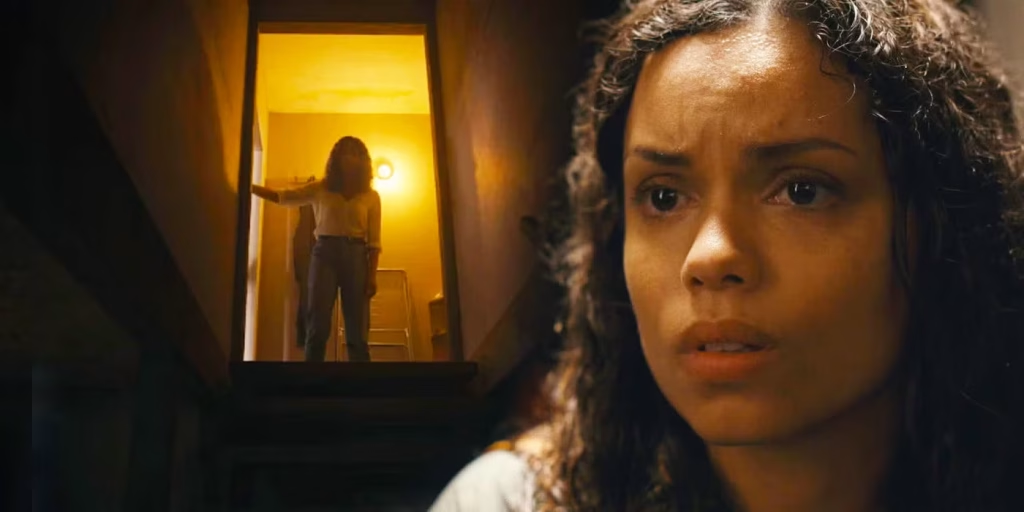
Tess and AJ are almost comically different horror protagonists, which is why the movie gets such a jolt when it hands the story to him. Tess sees the house as a threat. AJ sees it as square footage.
That one gag says everything.
He finds hidden tunnels and immediately starts measuring them like he has discovered bonus real estate. It is funny because Justin Long plays AJ with such rancid confidence, but it is also a brutal contrast. Tess looks at the basement and understands violation. AJ looks at it and thinks about value.
Tess’s fear has knowledge in it. AJ’s confidence has emptiness in it.
That is one reason Tess stands out among 2020s horror leads. She has instincts the movie respects. When she is afraid, the film does not treat her as hysterical. When she hesitates, it does not treat her as foolish. Her body is telling her the truth long before the plot fills in the details.
Even after she is dragged into the house’s deeper horrors, Tess keeps solving problems. She studies the Mother’s behavior. She picks up on patterns. She understands that panic will get her killed faster than disgust. She uses the creature’s need for caregiving when she has to, and that is a grim kind of intelligence too.
She adapts without turning into an action figure.
Her Smartest Trait Is Her Empathy
The easy version of Tess would be the woman who learns to stop caring. Lots of horror stories push characters toward hardness, as if survival means becoming less available to other people. Barbarian does something more interesting. Tess survives because she is perceptive, and her empathy is part of that perception.
She can tell Keith may be trapped. She can tell the Mother is dangerous, but also damaged in a way that makes simple hatred feel too small. She can tell AJ is a selfish disaster, and she still tries to keep him alive longer than he deserves.
That last part is maddening in the best way. By the time Tess is helping AJ, the audience has already watched enough of him to know he will probably fail any moral test placed in front of him. Tess helps anyway. Not because she is naive. Because she has a moral reflex that the movie refuses to frame as stupidity.
There is a difference between trusting the wrong person and refusing to abandon someone in terror. Tess keeps landing on the second one.
Her empathy also helps the film avoid making the Mother a simple monster machine. Tess responds to her as a threat, but she also grasps the tragedy underneath the violence. That does not make the basement less horrifying. It makes the horror uglier, sadder, and harder to shake off.
Tess Has the Intelligence of Lived Experience
Tess’s smarts feel so satisfying because they come from lived experience rather than exposition. She never gives a speech about being careful around men. She just behaves like someone who already knows the rules.
That is why the early scenes are almost more stressful than the creature horror. The double-booked rental feels plausible. Keith’s awkward kindness feels plausible. Tess’s little safety rituals feel painfully plausible. The movie turns ordinary female caution into suspense, and Campbell plays every beat with a lovely, frayed patience.
She is tired before the monster even shows up.
That tiredness makes her heroic in a quieter way. Tess keeps doing the work. She keeps looking, listening, reassessing. She keeps moving through fear without pretending fear has vanished. She is brave in the least flashy sense, which is often the most convincing one.
Horror characters get a bad reputation because audiences love pretending they would make perfect decisions under impossible pressure. Tess exposes how silly that game can be. She makes good decisions. She makes compassionate decisions. She makes decisions with incomplete information, while frightened, injured, and dismissed by people who should help her.
That is the actual test.
The Ending Proves How Rare She Is
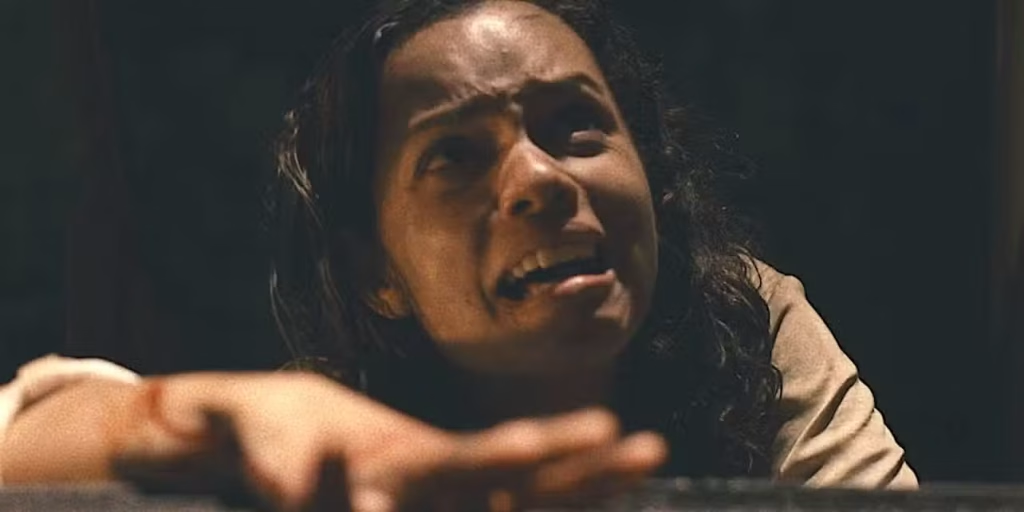
By the end of Barbarian, Tess has been through a whole catalogue of horror punishments, and the movie has stripped away almost every illusion of safety. The house offers no refuge. The police offer no refuge. Male charm, male guilt, and male authority all fail in different ways.
Tess remains the only person in the film who consistently sees other people clearly.
That is why she stays with you. Not because she is perfect. Perfect horror characters are boring little strategy diagrams. Tess is memorable because she is smart and still vulnerable, cautious and still humane, frightened and still capable of action.
Georgina Campbell gives her a face that always seems to be processing five things at once. You can see the dread arrive before she speaks. You can see her choosing the least terrible option in real time. That performance is the reason Tess feels like more than the “final girl” label, even though she absolutely earns her place in that lineage.
She is one of the smartest horror protagonists of the 2020s because her intelligence has texture. It looks like social fluency. It looks like suspicion. It looks like compassion that survives past the point where most people would call it quits.
And in a horror decade full of trauma metaphors, legacy monsters, cursed objects, elevated grief, and very pretty people walking toward terrible sounds, Tess stands out because she keeps doing the most frightening thing of all.
She pays attention.

Rachel Sikkema is a New Zealand-based writer and creative entrepreneur who explores the intersection of film, culture, and modern relationships. Through her articles, she examines how stories shape the way we connect, love and see ourselves – all for God’s glory. When she’s not writing about film and television, she’s watching Dexter and The White Lotus for the third time.