The most frightening thing about The Backrooms is how little drama it gives you at first.
Chiwetel Ejiofor’s Clark walks into those yellow rooms and the place almost looks bored by him. No thunder or gothic doorway. No grand horror welcome. Just carpet, humming lights, cheap walls, and hallways that seem to have been designed by someone with a deep personal grudge against direction.
That is why Kane Parsons’ movie understands the original internet nightmare so well. The Backrooms takes a fear everyone knows and strips it down until it becomes absurdly pure. Getting lost. That little childhood panic, the one that hits when a parent disappears around a supermarket aisle or a hotel corridor suddenly looks unfamiliar, stretched into a whole universe.
The maze scares because it offers the oldest possible problem in the dullest possible wrapping.
Where am I?
Then the worse question arrives.
How long have I been here?
Clark Gets Lost in a Place That Should Make Sense
Ejiofor gives Clark the exact energy this story needs. He looks like a man who has spent his adult life trusting that buildings follow rules. Doors open into rooms. Hallways lead somewhere. Corners have logic. Floors obey the decency of being finite.
The Backrooms takes all of that and quietly laughs.
Clark moves through the maze with a kind of practical concentration that makes the fear worse. He pauses, listens, checks sightlines, studies the angles. You can feel him trying to turn panic into a plan. Ejiofor plays that very well. His Clark keeps reaching for adult competence, and the rooms keep making competence look embarrassing.
That is such a mean trick.
A monster can be fought, dodged, maybe understood. A maze like this attacks the part of the brain that believes the world has a layout. The Backrooms turns space itself into a liar. One hallway looks like progress. Another leads to a room that feels copied from the last room. A corner offers hope for about half a second, then delivers more yellow wall.
Clark’s fear builds because he keeps recognizing the pieces while losing the whole.
The Internet Made the Perfect Lost Place
The Backrooms became one of the internet’s defining horror ideas because it feels like a place discovered by accident. That is crucial. It has the texture of a cursed image, a forum post, a screenshot passed around because nobody can quite explain why it feels wrong.
The concept grew out of online folklore, which suits it perfectly. The internet itself has always had a little Backrooms energy. Tabs inside tabs. Dead links. Old pages with broken images. Comment threads from years ago, still sitting there like abandoned rooms. You click one thing, then another, then realize you have wandered somewhere strange and faintly embarrassing.
Parsons’ movie gives that digital feeling physical shape.
The yellow maze feels like the architectural version of losing your way online. Familiar pieces keep appearing, but context falls away. Office walls, empty rooms, commercial carpet, fluorescent panels. Each element belongs to ordinary life. Together, they form a place with no map and no social contract.
The Backrooms feels made for the internet because it understands endlessness. You can always scroll farther and click deeper. You can always open one more door.
That is the trap.
The Fear Comes From Repetition

Getting lost in a forest has its own kind of horror. Trees repeat. Paths vanish. The sky changes. Nature can make a person feel small very quickly.
The Backrooms uses repetition in a colder way.
The rooms repeat without beauty. That matters. A forest has life in it, even when it scares you. The Backrooms has only stale design choices. Yellow wallpaper. Carpet. Ceiling tiles. Blank columns. The maze feels manmade, but made by no one who cared about human feeling.
Every repeated room becomes a tiny insult. It tells Clark that his movement may mean nothing. He can walk, turn, run, double back, follow a sound, count his steps. The place absorbs those decisions and gives him more of itself.
That is what makes it so good as horror about getting lost. It captures the moment when navigation stops being practical and becomes psychological. You begin by asking which way to go. Then you start wondering whether direction has any meaning in the first place.
That is where the panic gets interesting.
Renate Reinsve Makes the Maze Feel Personal
Renate Reinsve’s Mary gives the movie an emotional counterweight to Clark’s spatial terror. She brings the outside world with her, along with the fear of trying to reach someone who has vanished into something impossible.
Reinsve has a very controlled kind of intensity. As Mary, she makes worry feel sharp rather than sentimental. Her scenes matter because getting lost has a special cruelty for the people left behind. The missing person experiences the maze. Everyone else has to live with the absence.
That turns The Backrooms into more than a hallway nightmare. Clark’s disappearance creates a human wound. Mary’s search adds urgency, but it also deepens the film’s central dread. The Backrooms may look like a place, but it behaves like a rupture. People go in, then the world around them has to deal with the hole they leave.
Mary makes the maze feel contagious. Once someone disappears into it, ordinary rooms start to feel less reliable. Doors become suspicious. Blank walls seem to be withholding something. A normal building can carry a little aftertaste of the nightmare.
The best horror does that. It makes your own surroundings feel newly rude.
Mark Duplass Gives the Panic a Human Messiness
Mark Duplass brings a useful awkwardness to The Backrooms. His presence adds the kind of ordinary human friction that makes impossible situations feel grounded. People talk too much and try to manage fear through procedure. People make bad decisions while sounding very reasonable about them.
That is exactly the right texture for a movie about a supernatural maze hiding behind everyday spaces.
The Backrooms has a corporate, procedural ugliness to it. It feels adjacent to offices, storage rooms, service corridors, retail back areas, and institutional buildings where nobody wants to spend longer than required. Duplass fits that world because he can make normal conversation feel slightly off balance.
Getting lost becomes scarier when the people around the maze treat it like something that can be handled. The film has a nice chill in the gap between human confidence and the scale of the place. Everyone wants a system. The Backrooms offers square footage instead.
Finn Bennett and Lukita Maxwell also help widen the sense of a shared nightmare. The maze works best when it seems capable of swallowing different kinds of people, each with their own assumptions about what a room is supposed to do.
The rooms prove everyone wrong.
The Backrooms Turns Wayfinding Into Horror
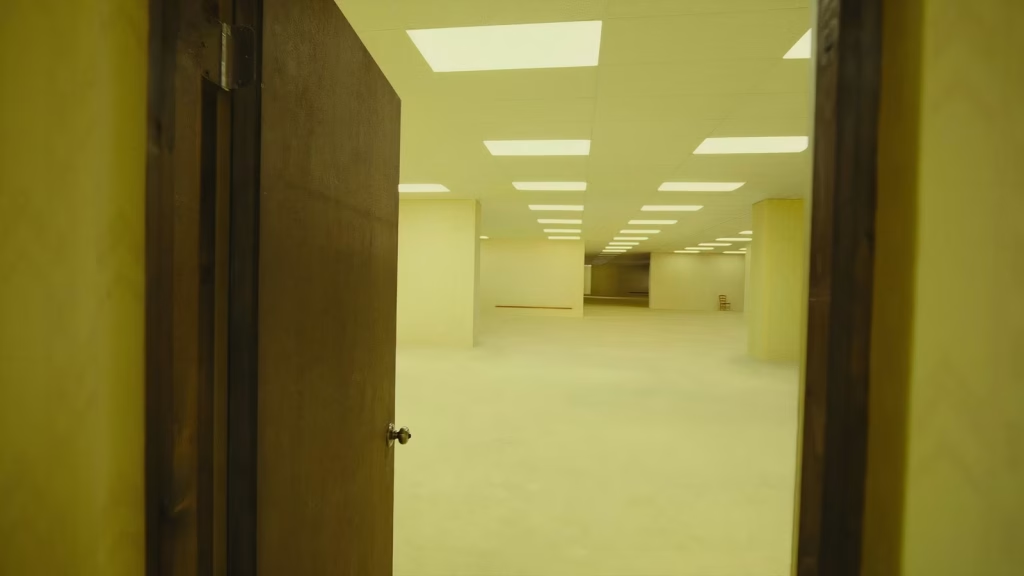
Most of daily life relies on tiny acts of navigation. We read signs without thinking. We follow light. We trust entrances and exits. We understand the emotional grammar of buildings. A lobby tells us one thing. A bedroom tells us another. A hallway promises transition.
The Backrooms corrupts that grammar.
A hallway stops being a route and becomes a sentence with no ending. A room stops being a destination and becomes another pause before more confusion. Light stops feeling helpful because it reveals nothing new. Even open space feels oppressive because it offers too many useless possibilities.
That is the specific nightmare the movie catches. Getting lost in the Backrooms means losing trust in spatial language. The building keeps speaking in words you know, but the sentence has become nonsense.
Parsons’ visual style is perfect for that. The camera often lets the rooms sit there with a horrible patience. It gives viewers time to scan the frame, choose a possible exit, suspect a corner, and imagine how far the maze could go. The film makes you participate in the navigation, then makes your participation feel pointless.
A little cruel. Very effective.
The Scariest Map Is No Map at All
The Backrooms has gathered a lot of lore over the years. Levels, entities, rules, factions, survival guides, diagrams. That kind of expansion can be fun. Internet horror thrives when people build myths together.
Still, the deepest fear sits in the unmapped version.
A map would give the Backrooms a shape. It would make the terror smaller by giving it edges. The original nightmare works because the place feels too bland to be mythical and too endless to be real. It has the emotional logic of a nightmare where every door leads to the same bad feeling.
Clark’s journey taps directly into that. Ejiofor plays him as someone who wants a map even before he has paper. His face keeps searching for pattern. Mary wants answers. Others want control. The Backrooms gives them repetition, distance, and that terrible electric hum.
It withholds the one thing lost people need most.
Orientation.
Getting Lost Is the Whole Monster
The reason The Backrooms remains such a powerful horror idea is simple. Its best monster is the loss of direction itself.
The creatures matter. The lore matters. The final reveals and strange copies add their own nasty flavor. But the concept’s grip comes from the empty stretch before the threat arrives, when a person stands under fluorescent lights and realizes every possible path may lead deeper in.
That fear lives below language. It is small and childish and adult at the same time. Everyone has known some version of it. Turning around in a store and seeing the wrong aisle. Walking through a parking garage and forgetting the level. Taking a hotel corridor that seems to repeat forever after midnight.
The Backrooms takes that ordinary disorientation and gives it no ending.
That is why it may be the internet’s best nightmare about getting lost. It feels born from a collective memory of wrong rooms, strange hallways, and places we passed through without wanting to remember them. Parsons takes those spaces seriously. Ejiofor, Reinsve, Duplass, Bennett, and Maxwell give them human fear to feed on.
The maze never needs to explain itself fully. It only has to keep going.
By the time Clark stands in another yellow room, listening to the lights and looking for a way out, the movie has already made its point. Getting lost can be scarier than being chased because getting lost gives fear time to settle in.
And in the Backrooms, time has plenty of room.

Rachel Sikkema is a New Zealand-based writer and creative entrepreneur who explores the intersection of film, culture, and modern relationships. Through her articles, she examines how stories shape the way we connect, love and see ourselves – all for God’s glory. When she’s not writing about film and television, she’s watching Dexter and The White Lotus for the third time.