
Guillermo del Toro’s Frankenstein (2025) is the kind of movie that feels straightforward on a first watch. You get the big emotions, the thunderstorm spectacle. You also get Oscar Isaac spiraling as Victor Frankenstein and Jacob Elordi towering over everyone as the Creature. Underneath all that though, the film is packed with quiet choices that deepen what the story is doing.
The Arctic Opening Is Doing More Than Setting Mood
The movie starts on the Horisont, a Royal Danish Navy ship trapped in the ice near the North Pole. This is where a dying Victor is found and the Creature boards the ship to demand his “father.” From there, the story fractures into sections: a Prelude on the ship, “Victor’s Tale,” “The Creature’s Tale,” and the Finale.
That structure quietly mirrors the original novel’s layered storytelling, where you move from ship captain to Victor to the Creature and back again. Del Toro pares it down to two main voices, but he keeps that nesting effect. Your first watch might feel like a simple flashback framework. On a rewatch, it plays more like a confession duel. The film keeps reminding you that everything you hear is coming through someone’s memory, which makes the Creature’s version of events land as a corrective, not just “the other side.”
War Profiteers and the Economics of Death
Victor’s research is funded by arms merchant Henrich Harlander, who gives him an isolated tower and essentially unlimited money as long as he delivers results. The bodies that fill Victor’s lab come from hanged criminals and soldiers killed in the Crimean War, which is raging in the background.
It is easy to treat Harlander, played by Christoph Waltz, as a familiar gothic villain who just wants to live forever. Underneath that, the film is making a very pointed connection. The only reason Victor can “cure death” is that modern warfare is churning out corpses on an industrial scale. Science is literally building on mass death.
The Creature as Victor’s Unwanted Heir
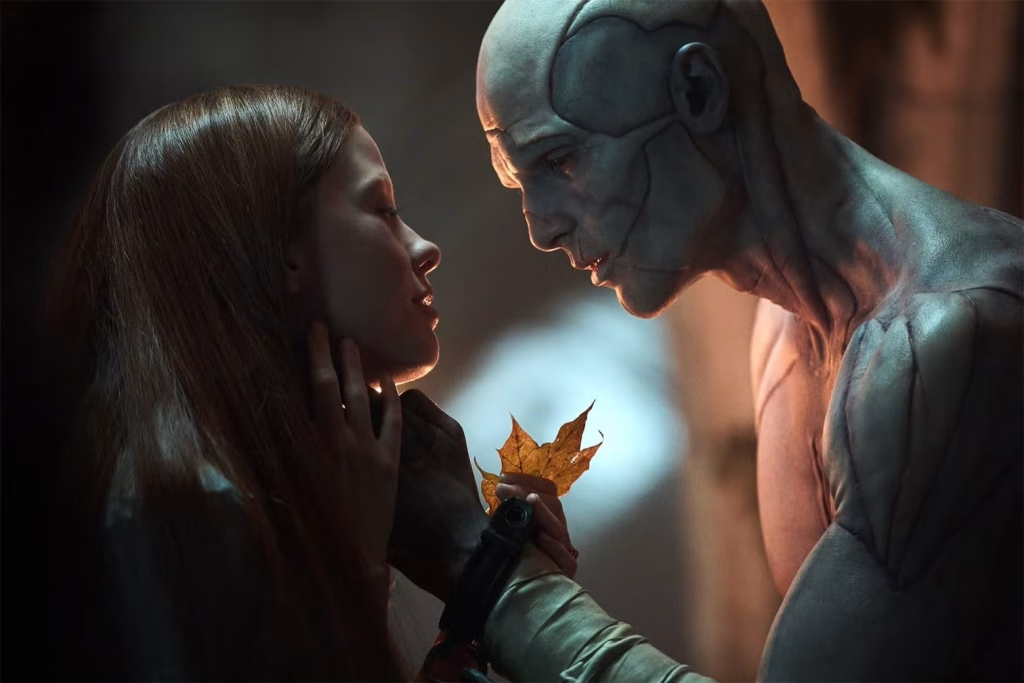
This Creature heals fast, survives gunshots, and cannot seem to die, which is a twist that sets up the ending where he frees the ship from the ice and walks into an uncertain future instead of throwing himself into it.
That has a hidden cost. If the Creature cannot die, then he is stuck carrying Victor’s legacy forever. Victor’s whole life is about conquering death and securing a name that will outlive him. He technically does it. He just hands immortality to someone who never asked for it.
The Double Mia Goth Casting Is Not Just a Flex
Mia Goth plays both Elizabeth Harlander and Victor’s late mother, Baroness Claire Frankenstein. If you missed that in the credits, it unlocks Victor’s inner life. He falls for Elizabeth, his brother William’s fiancée, yet she literally shares a face with his idealized memory of his mother. That is not subtle once you know it, but the movie never stops to underline it.
A Small Farmhouse That Hides a Big Literary Reference
Midway through the film, the Creature hides in the mill gears of a rural farm, watches a family through the walls, and becomes an unseen helper they call the “Spirit of the Forest.” He later befriends the family’s blind patriarch, who teaches him to read and speak.
If you have read the novel, that stretch is a clear echo of the De Lacey cottage chapters, where the Creature secretly observes a family and learns language and human kindness from them. Del Toro makes the homage more folkloric with the forest spirit idea and uses the machinery of the mill as a visual prison. The Creature is literally inside the machine that grinds out the family’s survival.
Monsters, Saints and a Catholic Eye

Del Toro has been open about approaching the story from a Catholic, Latin American perspective, and about seeing monsters as a kind of alternative saint from his childhood onwards.
You can see that in how the Creature is framed. The film returns again and again to images of him in poses that recall martyr paintings. He is chained, pierced, lit from above, or framed in doorways like old religious art. That is not accidental. Del Toro has talked for years about being fascinated by the way saints are depicted as both suffering and radiant, and that visual language carries over here.
Casting Easter Eggs in Victor’s Family Tree
One fun bit of meta casting: Charles Dance, who plays Victor’s cold, aristocratic father Baron Leopold Frankenstein here, previously played a different Frankenstein patriarch in the 2015 film Victor Frankenstein.
In practice, he turns into a walking curse. For viewers who recognize him, his presence connects this movie to a whole history of Frankenstein adaptations. Even if you do not know his filmography, the character is a living embodiment of inherited violence. The way he talks about discipline and legacy flows straight into Victor’s own harsh treatment of the Creature later.
The Ending Quietly Rewrites the Creature’s Fate
In many classic versions of the story, the Creature heads into the Arctic to die after Victor’s death. Here, after forgiving Victor, he uses his strength to push the Horisont free of the ice and essentially saves everyone else, then stays behind and reaches toward the sun.
That small adjustment has big implications. The Creature is no longer a figure who vanishes into guaranteed doom. He is a being who chooses solitude but is now visibly capable of protecting others, not just harming them. It also pays off a detail from earlier in Victor’s teaching, when the scientist frames sunlight and warmth as something the Creature should seek.
Why These Details Matter
All of this lives under the surface of a film that also happens to be a big Netflix hit, pulling tens of millions of views worldwide and sitting at the top of the platform’s charts soon after release.
On paper, that makes it a glossy genre event. In practice, it feels like the culmination of a three decade obsession for Guillermo del Toro, from the Bernie Wrightson inspired designs to the Romantic and gothic film influences he has cited as touchstones.

Rachel Sikkema is a New Zealand-based writer and creative entrepreneur who explores the intersection of film, culture, and modern relationships. Through her articles, she examines how stories shape the way we connect, love and see ourselves – all for God’s glory. When she’s not writing about film and television, she’s watching Dexter and The White Lotus for the third time.