
Paul Thomas Anderson’s One Battle After Another looks, on paper, like a pretty straightforward engine: former revolutionaries, an old enemy resurfaces, a daughter in danger, everyone back on the run. And sure, it delivers the propulsive thrills you’d expect from a film marketed as a black comedy action thriller.
But the movie’s real fixation is less “Who wins?” and more “What keeps repeating?” It’s a story about how violence comes back wearing a new outfit, how history changes its hairstyle and still shows up at your door, and how the hardest thing isn’t surviving the chase, it’s surviving the part where you realize you’ve been running in circles.
The Film Treats Violence Like a Pattern, Not an Event
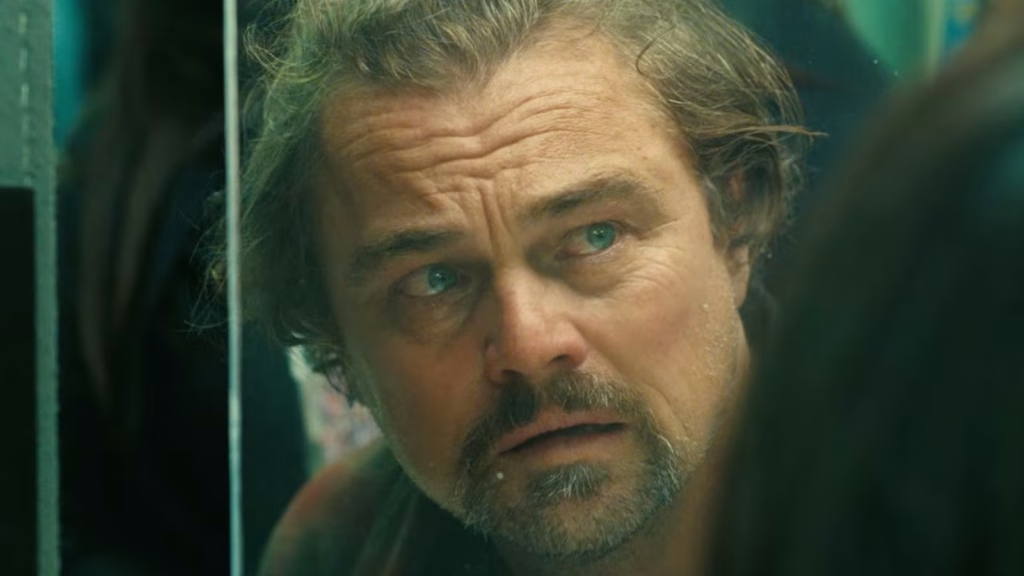
The cleanest way in is through Bob Ferguson, formerly “Ghetto” Pat Calhoun, played by Leonardo DiCaprio. He’s an ex-revolutionary and explosives guy who has rebranded into off-the-grid survival mode, which is basically activism’s hangover turned into a lifestyle.
The film draws a nasty little line between political violence and personal violence: both can start as “necessary,” both can become habitual, and both can leave you telling yourself a story about who you are so you don’t have to look too hard at what you did. Bob’s paranoia isn’t only comic texture. It’s the psychological bill arriving years late.
The Cyclical Part Hits Hardest in the Parent-Child Dynamic
Chase Infiniti’s Willa Ferguson is the movie’s emotional live wire, because she’s young enough to want a clean mythology and old enough to sense that the adults around her are lying by omission.
Anderson makes the generational handoff feel uncomfortably physical. Willa inherits the consequences of choices she didn’t make, plus the unfinished arguments her parents had with the world. Teyana Taylor’s Perfidia Beverly Hills isn’t framed as a symbol; she’s a person whose ideology and appetite for risk ripple outward into a kid who has to become fluent in danger just to understand her own origin story.
Why the Story Is Built Like a Maze, Not a Mountain
A “mountain” story climbs. It has a clear ascent, a peak, a resolution that feels like a view. A “maze” story keeps doubling back, changing names, switching corridors, making you doubt you’ve ever been oriented at all.
One Battle After Another is aggressively maze-like. Characters hold multiple identities, the past hides inside the present, and the film keeps revealing that the thing you thought was “backstory” is actually the current plot wearing a trench coat. Even the central conflict is designed as recurrence: Sean Penn’s Colonel Steven J. Lockjaw doesn’t simply return; he embodies the idea that what you humiliated or harmed earlier can mutate into a long-term obsession with payback and control.
The maze feeling is also structural. The movie moves like a chain of escape routes: tunnels, rooftops, back passages, secret codes, hidden networks. It’s not just chase choreography, it’s theme made physical. Survival depends on knowing the right turn at the right time, and half the tragedy is that the “right turn” often belongs to somebody else’s plan.
Comedy Works as a Pressure Valve, and as Misdirection
Anderson frames this as a black comedy for a reason. The laughs are rarely there to relax you. They’re there to show you how people cope when the moral math gets too ugly.
Bob’s stoner paranoia plays funny until you notice it also keeps him from being present as a father. Revolutionary nicknames are funny until you clock how they let adults avoid accountability. Even the concept of an elite secret society has a satirical bite, right up until it stops being a joke and starts functioning like a machine.
The comedic tone also mirrors the maze idea. Jokes pull your attention sideways. They make you miss the trapdoor until you’re already falling.
The Film’s Politics Live in Atmosphere and Logistics
This is one of those movies where ideology shows up less as speeches and more as infrastructure. Who can move freely, gets raided and has cover stories. Who has to memorize codes and can disappear and who gets hunted.
Benicio del Toro’s Sergio St. Carlos, Willa’s karatedo teacher and a leader in his community, functions as an anchor in the middle of the chaos. He’s the film’s reminder that “violence” isn’t only gunfire and car crashes. It’s policy, surveillance, intimidation, and the ever-present threat of removal. Wikipedia
The Music and the Image Make the Loop Feel Inevitable
Jonny Greenwood’s score is part of the maze-building. It pushes, jitters, and tightens, like the sound of thought spiraling when you’re trying to remember the code that will save your life. The soundtrack release notes also underscore how central Greenwood’s long collaboration with Anderson is here.
Visually, the movie leans into big-format spectacle, including VistaVision and IMAX presentation, which matters because scale changes how repetition feels. On a huge screen, a chase isn’t only action. It’s the body experiencing the loop, again and again, with nowhere to look away.
What the Film Ultimately Argues About Breaking the Cycle

The bleak trick about cyclical violence is that it can feel like fate. The movie’s smarter than that, but it doesn’t offer a tidy cure either. It suggests that breaking a cycle isn’t a heroic peak moment. It’s a series of small, stubborn refusals: refusing the story that makes violence glamorous, refusing the lie that your past can’t catch you, refusing to hand your kid a mythology that turns them into your sequel.
Anderson builds the film like a maze because that’s what living inside these patterns feels like. You don’t march upward toward enlightenment. You backtrack, you panic, you make the wrong turn, you find the same hallway again, and sometimes the only victory is noticing the loop before it closes.

Rachel Sikkema is a New Zealand-based writer and creative entrepreneur who explores the intersection of film, culture, and modern relationships. Through her articles, she examines how stories shape the way we connect, love and see ourselves – all for God’s glory. When she’s not writing about film and television, she’s watching Dexter and The White Lotus for the third time.