
At first glance, The Rip sells you a simple hierarchy. Lieutenant Dane Dumars (Matt Damon) is the boss. Detective Sergeant J.D. Byrne (Ben Affleck) is the seasoned right hand who knows how the unit actually works. Everyone else in the Tactical Narcotics Team is trying to do the job, keep the vibe steady, and go home in one piece.
Then the movie hands them a stack of cash so large it stops feeling like evidence and starts feeling like gravity. The moment that money hits the room, power stops being about rank and starts being about who can control the story, the clock, and the fear.
The First Power Move Is Information, Not Violence
The smartest, most unsettling choice Dumars makes is not tactical. It’s social. He keeps everyone slightly off balance by controlling what they know and when they know it. Even early on, the movie frames Dumars as someone who understands that authority is half badge and half narrative. If you can shape the narrative, you can shape the room.
That’s why the stash house discovery lands like a psychological trap. The money is real, but the bigger threat is the uncertainty: Who knows how much? Who has called someone? Who is already planning their exit?
Once trust becomes the scarce resource, the person with the cleanest access to information becomes the person with the most power. Dumars understands that before anyone else admits it out loud.
Dumars Has Rank, but Byrne Has Leverage
Dumars is the newly promoted lieutenant, and that matters. Promotions change friendships in ways nobody wants to discuss, especially in a unit that runs on shared history and unspoken favors.
Byrne’s power is different. It comes from social capital. He’s been there, he’s earned the trust, and he knows how the team reads a situation before the situation finishes happening. Byrne can’t always overrule Dumars on paper, but he can turn the room with a look. He can plant doubt without saying the loud part.
Mike Ro, Baptiste, and Salazar Show How Power Spreads Sideways

If you only track Dumars and Byrne, you miss the way power moves laterally through the team.
Detective Mike Ro (Steven Yeun) is the clearest example of “mid-level” power: close enough to leadership to see the cracks, not secure enough to feel protected. Ro reads as competent, dedicated, and increasingly disillusioned, which is exactly the kind of person a crisis can bend in unpredictable directions.
Detective Numa Baptiste (Teyana Taylor) brings a different kind of authority: composure. When everyone else starts performing, she looks like someone who can keep her head. In a chaos situation, that becomes power. People watch the calm person to figure out how scared they should be.
Detective Lolo Salazar (Catalina Sandino Moreno) adds the wild card energy that the movie uses like a live wire.
The Outside Badges Matter More Than the Inside Ones
The second the situation becomes “bigger than the unit,” institutional power starts closing in.
DEA Agent Matty Nix (Kyle Chandler) represents a very specific threat: the friend who is also a watchdog. He’s positioned as a peer, not a boss, but his presence changes behavior because he’s connected to consequences. He doesn’t need to shout. He just needs to exist in the scene and the room starts to self-police.
Then you have FBI Agent Del Byrne (Scott Adkins), who arrives carrying both institutional authority and personal ties, since he’s J.D.’s brother. That combination is nasty, because it means the conflict is not purely professional anymore. It’s family, pride, and old wounds with a federal seal on top. When that kind of figure enters the story, he doesn’t have to win fights. He can win by forcing choices.
And looming over all of it is the command structure. Major Thom Vallejo (Néstor Carbonell) is the reminder that the department is a machine. Units might have loyalty, but institutions have pressure, optics, and the desire to contain messes.
So who holds the power? Sometimes it’s the person with the gun. More often it’s the person who can decide what the official story will be.
Captain Jackie Velez’s Shadow Controls the Room
Captain Jackie Velez (Lina Esco) is murdered before the story fully gets going, and yet she hangs over everything. Her absence creates the vacuum that everybody tries to fill.
A dead leader has a strange kind of power. You can’t argue with her. You can’t clarify what she would have wanted. You can only weaponize your interpretation of her. People invoke her memory to justify decisions, to accuse each other, and to cover their own fear. That’s not sentimental. It’s strategic.
The film uses Velez’s death as the reminder that leadership is fragile, and that “the chain of command” is only meaningful until the moment it snaps.
Power in the Rip Belongs to Whoever Can Survive the Longest Without Flinching
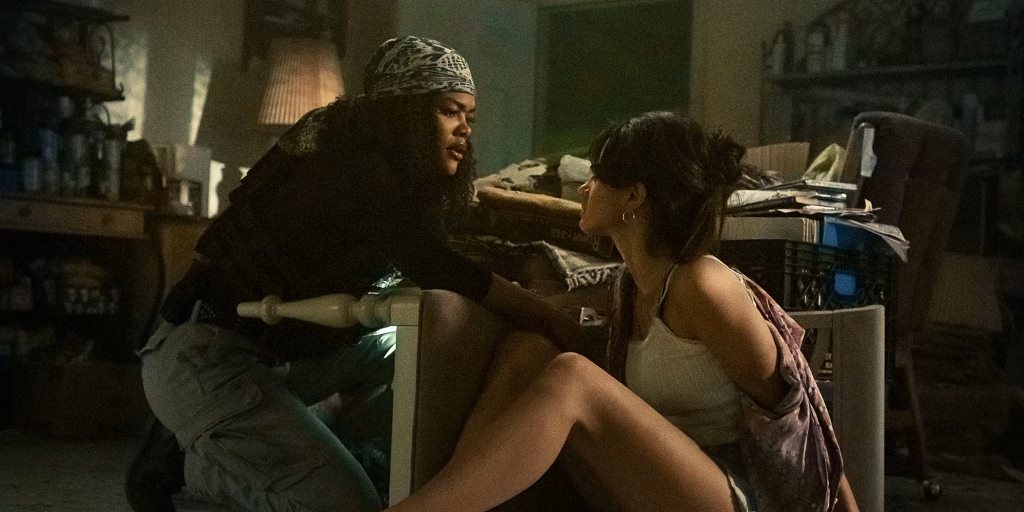
By the time the night tightens, power has changed hands so many times it stops being a title and starts being a condition. Who can keep their voice steady. Who can look someone in the eye and not blink. Who can delay a decision just long enough to make everyone else reveal themselves.
Dumars has rank. Byrne has influence. The feds have authority. The department has consequences. The money has gravity. And the civilians caught in the blast radius can still tip the whole thing with one truth at the wrong moment.
So who really holds the power in The Rip? The movie’s mean little answer is that nobody holds it for long. Power is a hot object in this story, and the only winners are the ones who figure out when to drop it.

Rachel Sikkema is a New Zealand-based writer and creative entrepreneur who explores the intersection of film, culture, and modern relationships. Through her articles, she examines how stories shape the way we connect, love and see ourselves – all for God’s glory. When she’s not writing about film and television, she’s watching Dexter and The White Lotus for the third time.