
People love to call Heathcliff romantic, but that label has always done a lot of heavy lifting.
Yes, he is intense and loves Cathy with a kind of all consuming force. Yes, Jacob Elordi has the face and presence to make a room go very quiet very quickly. But in this Wuthering Heights version, the film keeps pulling us back to a harder truth. Intensity is not the same thing as tenderness, and obsession is not proof of deep love.
That is what makes Elordi’s Heathcliff feel so unsettling. He is not just a man in pain. He is a man who turns pain into leverage. The character still has the tragic pull people expect, but this version leans into the part that often gets softened in pop culture.
He Is Built to Pull People in First
Elordi’s casting is clever because the film knows exactly what audiences bring with them. He already carries a modern screen image that reads as brooding, attractive, emotionally loaded. The movie uses that. It does not fight it.
For a while, that works on you. You understand why Cathy is drawn to him. You understand why people watching might be tempted to read him as a dark fantasy instead of a danger sign. He has charisma, and charisma can make bad behavior look like mystery if a film is not careful.
This one is careful.
It keeps showing the cost of his presence. Every moment that looks romantic on the surface has something sharp underneath it. A stare lingers too long. A silence feels controlling. A reunion feels less like warmth and more like a score being settled.
That shift is where Elordi’s performance really lands. He does not play Heathcliff like a man overflowing with love. He plays him like someone who cannot separate love from possession.
The Film Treats Obsession as Damage, Not Destiny
A lot of adaptations get trapped by Heathcliff’s legend. They give you the stormy atmosphere, the longing, the class divide, the doomed chemistry, and suddenly the audience starts treating him like a tragic boyfriend poster.
This version feels more interested in what obsession actually does to people.
Heathcliff’s attachment to Cathy is real, but the film does not frame that as automatically noble. It shows how his fixation hardens him. He is not just heartbroken, he becomes punitive. He wants to hurt people, and not only because he was hurt first. At a certain point, cruelty becomes part of how he relates to the world.
That is an important distinction, and Elordi plays it well. He gives Heathcliff emotional force without asking for easy sympathy. You can see the wound and still recognize the threat. Honestly, that is a much more interesting performance than a simple “sad beautiful man” version.
Cathy Brings Out His Worst and His Truest Self
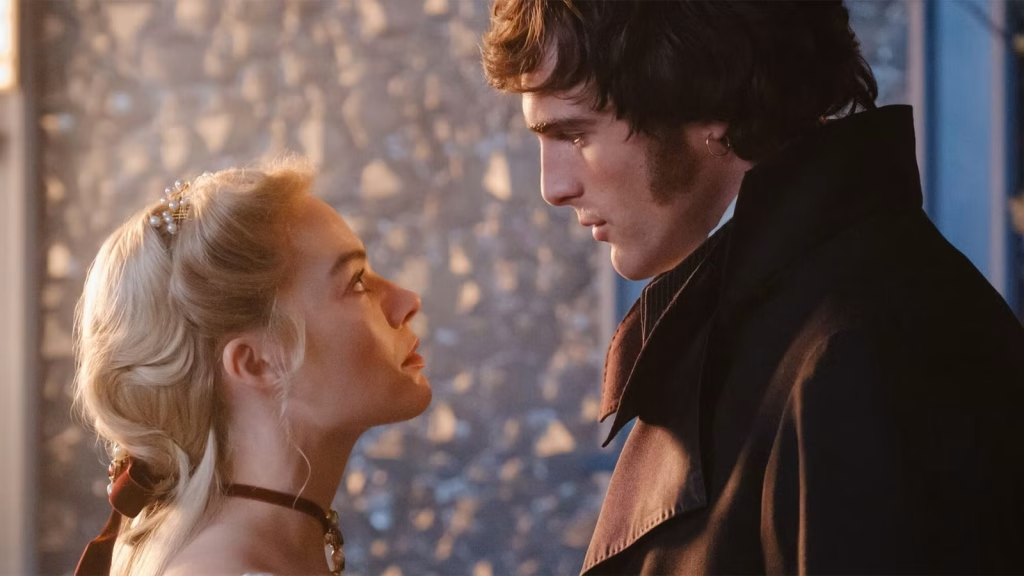
Margot Robbie’s Cathy matters here, because she keeps the relationship from turning into a one note story about a dangerous man and a helpless woman.
This Cathy has appetite. She wants status and heat and freedom and admiration, sometimes all at once. She is impulsive, proud, and capable of her own damage. That makes the connection between her and Heathcliff feel alive in a way that is hard to dismiss.
His Anger Is Rooted in Humiliation
What makes this version work for me is that Heathcliff is not written as a cartoon villain in expensive coats.
The story still carries the social humiliation that shapes him. He is treated as lesser, pushed down, watched, judged, and reminded where he stands. That matters. The class element is not background decoration. It helps explain why his anger is so volcanic and why his pride becomes almost impossible to separate from his identity.
But explanation is not absolution, and the film does not confuse the two.
Elordi plays Heathcliff like a man who learned early that vulnerability gets punished. So he builds himself into something harder. He becomes strategic and withholds. He retaliates. Even when he looks calm, you can feel the pressure under the surface.
That is why this Heathcliff feels more dangerous than romantic. He is not simply emotional, he is calculating with his emotions. Heathcliff knows what they do to people, and he uses that.
He Is Scariest When He Is Controlled
The easy way to play Heathcliff is to go big all the time. Rage, grief, wild declarations, shattered furniture, the whole Gothic package.
Elordi does something more effective. He often pulls back.
He lets the character’s calmness do the work. You get these moments where Heathcliff seems composed, almost gentle, and that is exactly when he becomes hardest to trust. The restraint feels deliberate. It feels like a man choosing when to reveal what he is capable of.
That choice gives the performance a nasty edge. You are not watching someone lose control. You are watching someone exercise it.
Why People Still Want to Romanticize Him

The funny thing is, even when a film makes Heathcliff’s cruelty obvious, people will still rush to defend him as romantic. Part of that is the story itself. It is Gothic and built from longing and weather and old wounds. It invites strong feelings.
Part of it is Elordi. He is very good at making contradiction visible. He can look wounded and threatening in the same scene. Elordi can make Heathcliff seem deeply attached while also making you think, this man is about to ruin someone’s life.
That tension is exactly why the performance sticks.
The film is not saying there is nothing seductive about Heathcliff. It is saying seduction is not the same thing as safety. That is a distinction viewers often blur, especially with characters who are written to feel mythic. This version keeps dragging him back down from myth to behavior.
And once you look at the behavior, the romance gets a lot less dreamy.
Jacob Elordi’s Heathcliff works because he gives us the attraction people expect and the danger people often excuse. He is not a misunderstood fantasy here. He is a man whose love is tangled up with pride, humiliation, control, and revenge. That makes him compelling to watch, but it also makes him the opposite of romantic in any healthy sense. This version understands that, and it is exactly why it feels sharper than a lot of adaptations that came before it.

Rachel Sikkema is a New Zealand-based writer and creative entrepreneur who explores the intersection of film, culture, and modern relationships. Through her articles, she examines how stories shape the way we connect, love and see ourselves – all for God’s glory. When she’s not writing about film and television, she’s watching Dexter and The White Lotus for the third time.