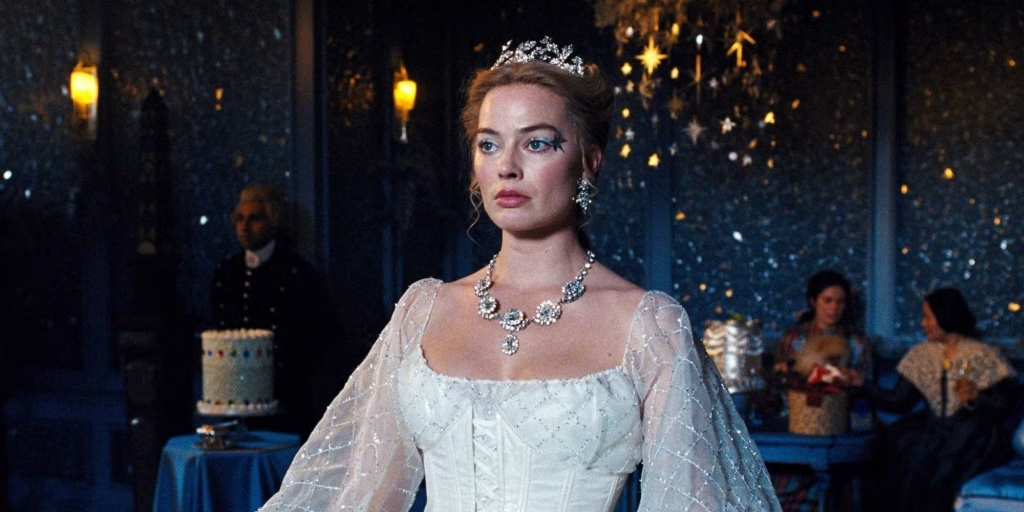
There are a million ways to sell Wuthering Heights (2026) to a modern audience, but Emerald Fennell clearly picked the messiest, most honest one. This is not a story where love heals people. Love here is gasoline. Class hands someone a match. Then revenge turns it into a controlled burn that absolutely no one controls.
With Jacob Elordi as Heathcliff and Margot Robbie as Catherine Earnshaw, the film leans into the thing that makes Wuthering Heights feel so nasty and so addictive. Every tender moment has a shadow behind it. Every promise is also a threat.
Class Is the First Wound, Not a Background Detail
If you want this story to make emotional sense, you have to start with class. Not the vague “oh, it’s a period piece” kind of class. The sharp, daily kind. The kind that decides who gets treated like family and who gets treated like a problem that wandered indoors.
Heathcliff arrives at Wuthering Heights as an outsider and stays one, even when he is physically inside the house. The film makes that outsider feeling cling to him. It shows up in the way people talk around him, the way respect gets withheld, the way power gets exercised casually, like it is weather.
Catherine Understands the Rules and Still Breaks Herself on Them
Catherine is often treated like a romantic symbol, but she is also a sharp observer of her world. She knows what status buys you and what poverty costs you. She also knows that being a woman in this setting means your choices get packaged as morality when they are really about survival and leverage.
Margot Robbie plays Catherine as someone with appetite. Appetite for experience, for intensity, for being seen, for getting what she wants. That is part of why she and Heathcliff feel so inevitable at first. They recognize the same wildness in each other. They also recognize the same rage at being boxed in.
Heathcliff Turns Hurt Into a System

The most interesting versions of Heathcliff are never the ones where he is only tragic. The point is that he learns. He adapts. He weaponizes what he has learned about power.
Elordi’s Heathcliff is dangerous in a quiet way. Even when the character is not shouting, you can feel the math happening behind his eyes. Who has the upper hand, who needs something. Who can be cornered or bought.
When Heathcliff returns with money and social force, he does not use it to build a softer life. He uses it to correct a score he has been keeping for years. That is where the revenge theme stops being a fantasy and starts being a study in contamination. Revenge does not stay neatly pointed at the person who first hurt you. It spreads, it finds bystanders and crawls into relationships that never asked to be part of it.
It is also where the film gets uncomfortable in the way it should. Watching an underdog come back powerful can feel satisfying for a minute. Then you realize you are watching someone recreate the cruelty that made him. He becomes fluent in the language of domination, and he starts speaking it constantly.
Power Lives in Homes, Not in Speeches
This story is obsessed with property, but it is even more obsessed with control. Who gets to set the emotional temperature of a room. Who gets locked into a role and told it is “just how things are.”
That is why the domestic spaces in Wuthering Heights always feel like battlegrounds. The fights are not only romantic. They are logistical, they are social. They are about inheritance, belonging, and who gets treated as legitimate. The film leans into that claustrophobia, where even a quiet conversation can feel like someone tightening a grip.
Characters like Nelly often carry the emotional labor of the house, and they also become the ones who see patterns repeating. She is not a neutral bystander. Nobody is. In a hierarchy, even survival can accidentally become complicity.
Revenge Keeps Going Because Shame Keeps Going
One of the most punishing truths in this story is that revenge is not a clean storyline with a satisfying end point. It is a habit and a coping mechanism. It is a way of turning humiliation into action so you never have to sit still with the pain.
Heathcliff’s revenge works because the world around him is built to support it. Social systems that rank people also create endless opportunities to hurt them. When you can control money, housing, reputation, and marriage, you can control someone’s life without ever raising your voice.
The Film Treats Romance as a Power Struggle, and That Is the Point

If you watch this version looking for a swoony period romance, you will probably feel bruised. The chemistry is there, but it is not safe. The attraction is real, but it is tangled up with possession, pride, and fear.
The film’s best moments are the ones where you can see how class pressure warps intimacy. Catherine and Heathcliff do not only love each other. They provoke and test each other. They try to win. The relationship becomes a place where they replay the power dynamics the outside world forces on them, except now they can hurt someone back.

Rachel Sikkema is a New Zealand-based writer and creative entrepreneur who explores the intersection of film, culture, and modern relationships. Through her articles, she examines how stories shape the way we connect, love and see ourselves – all for God’s glory. When she’s not writing about film and television, she’s watching Dexter and The White Lotus for the third time.