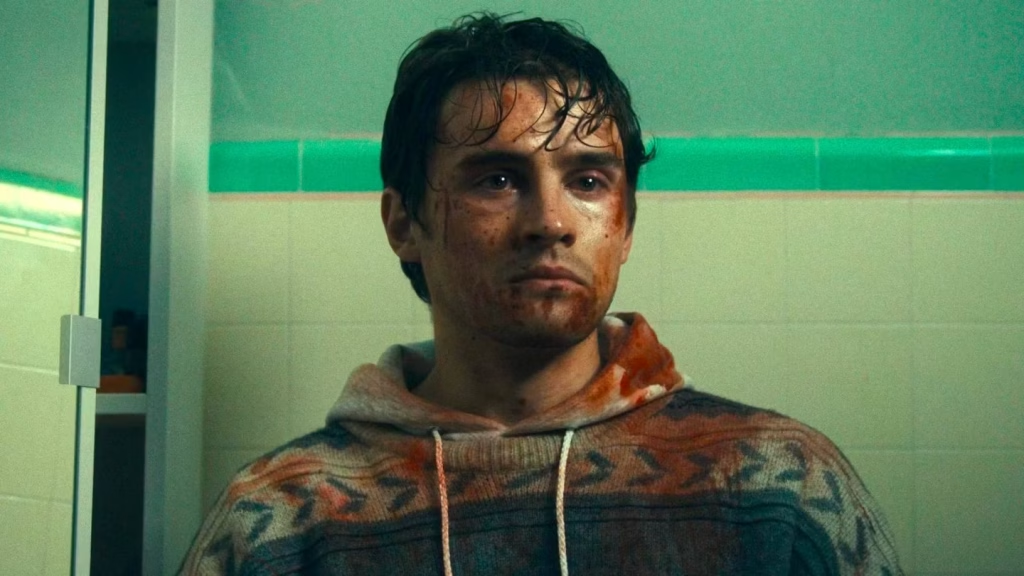
The saddest scene in Obsession might be the conversation Bear never allows himself to have.
Before the One Wish Willow twists affection into something ravenous, Bear and Nikki already possess the raw material of a relationship. They have history. They enjoy each other’s company. Nikki lets him see the uncertain parts of her personality that she keeps tucked beneath her confidence. More importantly, she keeps choosing to spend time with him.
That never proves she was secretly waiting for a kiss. Curry Barker leaves just enough space around Nikki’s feelings to prevent any clean answer. Yet the possibility hangs over the entire film. Bear may have used magic to force something that patience and courage could have allowed to grow on its own.
That possibility makes his wish so much worse.
Nikki Treats Bear Like Someone Who Matters
Inde Navarrette plays the early Nikki with an ease that feels very different from polite friendliness. Her warmth around Bear has a lived-in quality. These two have known each other long enough to skip the stiff small talk. She talks to him about her writing and seems comfortable sitting in the quiet with him.
Their car conversation carries most of the evidence. Nikki explains that she is writing a love story rather than a romance. Bear asks her about the distinction, and the mood briefly shifts. Her answer feels personal. She wants to understand love and perhaps feel it before she can write it properly.
There are several ways to read that exchange. Nikki could simply be sharing a creative frustration with a trusted friend. She could also be testing the emotional temperature inside the car. Bear has an opening to ask what she wants or tell her what he feels. He retreats into the familiar safety of implication.
Michael Johnston plays Bear as a man constantly preparing to speak. His feelings reach his face before they reach his mouth. Nikki can probably sense some of that. Most people would.
Her continued closeness suggests that his affection has not frightened her away. She gives him room. He fills that room with silence.
A Chance Means More Than a Secret Crush
The question tends to get flattened into a yes or no proposition. Did Nikki love Bear already?
The film asks something subtler. Could she have loved him?
Love rarely arrives fully formed while two people sit in a parked car. Interest grows through small risks, awkward admissions and the chance to respond freely. Bear skips that entire process. He wants the final answer without enduring the vulnerable middle.
Nikki may have been curious about him. She may have felt a flicker of attraction. Perhaps she saw him as a close friend and nothing more at that moment. All three possibilities remain alive before the wish.
That uncertainty terrifies Bear more than rejection. A rejection would hurt, but it would provide an answer. Uncertainty forces him to act without control over the outcome.
The One Wish Willow appears to solve that problem. It offers certainty without exposure. Bear gets to avoid the shaky confession, the pause before Nikki responds and the possibility that their friendship changes. He wishes himself past every human step that gives love its meaning.
He also removes Nikki from the decision.
Bear Confuses Fear With Fate

Bear imagines himself as someone trapped by bad luck. He loves Nikki, yet some invisible barrier keeps him from reaching her. His friends push him to confess. The opportunity keeps appearing. Still, he behaves as though circumstances have sentenced him to longing.
His real barrier is fear.
That distinction matters because the wish feels impulsive only on the surface. It grows from a habit of avoidance. Bear rehearses what he wants to say, delays saying it and then reaches for an object promising an effortless result. The magic merely gives physical form to the shortcut he already craves.
He wishes for Nikki to love him more than anyone in the world. Even the wording reveals how little room he has left for Nikki as a separate person. He never wishes for the courage to be honest or asks for clarity about her feelings. He chooses ownership disguised as devotion.
The tragedy comes from how unnecessary it all feels. Nikki remains emotionally available to him before the stick snaps. She talks, listens and spends time with him. Bear treats the absence of a guarantee as proof that he has no chance.
Every real relationship begins without a guarantee.
Wish Nikki Exposes What Bear Failed to See
After the wish, Nikki gives Bear the certainty he thought he wanted. Her attention becomes total. She watches him with terrifying concentration. Her voice, body language and sense of humour begin reorganising themselves around his desires.
At first, Bear experiences this change as a miracle. The speed should alarm him. Instead, it flatters him.
Wish Nikki behaves like someone performing an idea of perfect love assembled from Bear’s fantasies. She offers affection without hesitation and devotion without boundaries. There is no private corner of her life that remains untouched by him.
The result feels horribly empty. Bear wanted Nikki, but the wish destroys the very qualities that made her desirable. Her independence, unpredictability and inner life become obstacles to the command placed inside her.
Navarrette makes that loss visible. Early Nikki has a loose, alert energy. She seems to be thinking even when she says very little. Wish Nikki focuses so intensely on Bear that the rest of the room appears to vanish. Her affection has no air in it.
This is where the possibility of Nikki’s earlier feelings becomes especially painful. Bear receives a grotesque imitation of something he may have been close to earning honestly.
The Film Protects Nikki’s Ambiguity
Barker wisely avoids giving us a flashback in which Nikki confesses her hidden crush to another character. Such a scene would turn the film into a cosmic gotcha. Bear could have had the girl all along.
That would reduce Nikki to a prize waiting for the correct version of Bear to claim her.
Instead, her feelings remain her own. The audience can notice her warmth without converting every smile into romantic evidence. Friendship contains intimacy too. A woman sharing personal thoughts with a man does not create an unpaid romantic debt.
The uncertainty also preserves the moral weight of Bear’s choice. His wish would remain a violation even if Nikki had planned to confess her love the following morning. Existing attraction gives him no right to accelerate it through supernatural force.
Still, the film deliberately lets us imagine the road he abandoned. A genuine relationship might have developed. A gentle rejection might have freed him from years of fantasy. Their friendship might have survived an uncomfortable week and settled into a healthier shape.
Each outcome would have been better than certainty purchased with Nikki’s autonomy.
Nikki’s Survival Makes the Question Hurt More

When the curse finally breaks, Nikki returns to a life she barely recognises. Bear’s wish has moved through her body and left devastation behind. Other people will see evidence. Nikki carries an experience that sounds impossible.
The earlier question now feels almost cruel. Whatever she once felt for Bear has become irrelevant. He has contaminated every memory between them.
Imagine Nikki trying to remember that car conversation. Did she feel something? Was she considering him as more than a friend? Could their relationship have changed? Any honest answer has been buried beneath a version of love forced upon her so violently that it consumed everything nearby.
Bear wanted to escape uncertainty. Nikki inherits far more of it.
She must wonder which emotions belonged to her and which arrived through the wish. She has to live with actions performed by her body while her agency was trapped somewhere underneath. Even her fondest memories of Bear now lead toward the moment he chose control over trust.
That is the film’s nastiest consequence. The wish does more than ruin a possible romance. It steals Nikki’s ability to look back on that possibility without horror.
Bear Probably Did Have a Chance
Nikki’s early behaviour supports the idea that she felt some attraction, or at least enough emotional curiosity for a relationship to become possible. Navarrette has described the character as having feelings for Bear, while the film itself keeps those feelings deliberately unresolved.
So yes, Bear probably had a chance.
That answer offers him no defence. It condemns him.
He could have spoken and accepted embarrassment. He could have allowed Nikki to surprise him. Instead, he treated love as an outcome to secure rather than an experience two people build together.
The One Wish Willow grants Bear the thing he believes he lacks. It gives him Nikki’s certainty. In return, it destroys every reason her love would have mattered.
Perhaps Nikki would have loved him. Perhaps she already did, in some tentative and unfinished way. Bear never learns the truth because he replaces her answer with his own.

Rachel Sikkema is a New Zealand-based writer and creative entrepreneur who explores the intersection of film, culture, and modern relationships. Through her articles, she examines how stories shape the way we connect, love and see ourselves – all for God’s glory. When she’s not writing about film and television, she’s watching Dexter and The White Lotus for the third time.