
Guillermo del Toro’s Frankenstein hits differently when you stop treating it like a simple creator-versus-creation story and start watching it like a split screen of one man’s psyche. Victor Frankenstein and the Creature don’t read as enemies from different worlds. They read like the same emotional material, separated into two bodies, forced to confront each other in public.
Oscar Isaac’s Victor carries the part that wants mastery, certainty, and applause. Jacob Elordi’s Creature carries the part that wants warmth, belonging, and someone to tell him he isn’t a mistake. When you put them in the same frame, you get a strange, uncomfortable feeling: Victor didn’t invent life. He externalized himself.
Victor Creates a Mirror, Not a Miracle
Victor doesn’t build the Creature because he has a tidy scientific question. He builds him because Victor can’t live with human limits, especially the limits that make grief and love so painful. The experiment becomes a way to rewrite the rules of existence, but it also becomes a way to avoid being vulnerable.
That’s why the Creature feels like a mirror. Victor tries to manufacture a being who proves he’s exceptional, then he flinches the second the proof looks back at him. If your “great achievement” can speak, judge, and need you, it stops being a trophy and starts being a relationship.
The Creature Carries Victor’s Disowned Humanity
The Creature arrives innocent enough to be heartbreaking, and del Toro leans into that innocence as something real, not ironic. He’s not born evil. He’s born unfinished. He doesn’t know language, norms, or safety, and he is constantly reading faces for answers.
That’s the first way he becomes Victor’s other half. The Creature holds the raw human needs Victor tries to outrun: comfort, touch, patience, and guidance. Victor wants to be a god, but the Creature forces him to be a parent, and that role terrifies him.
Their Eyes Tell the Whole Story
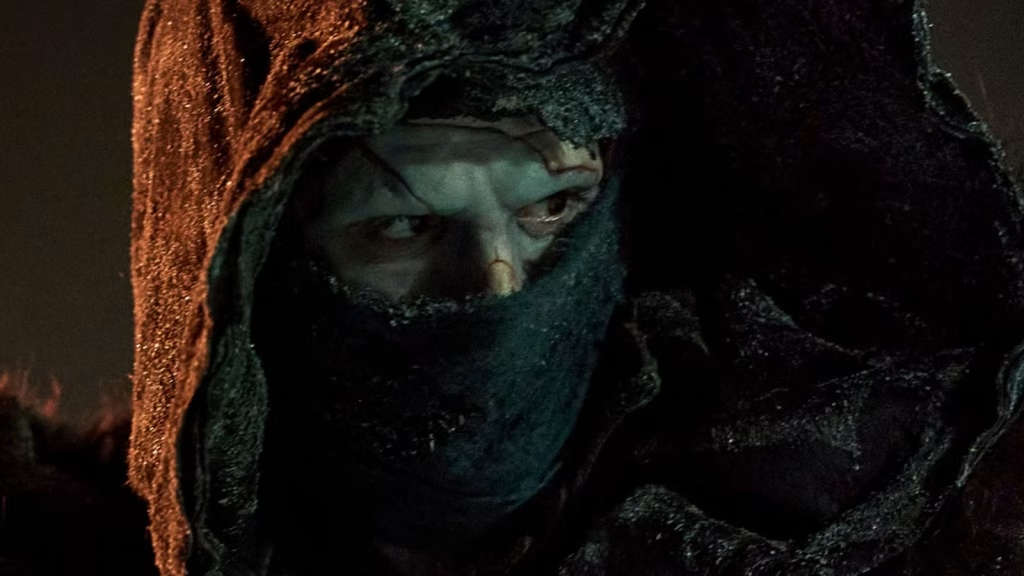
Del Toro has talked about why Isaac and Elordi work as a pair, and the reasoning is almost funny in how simple it is. Victor needs eyes that can look tortured while still believing he’s the good guy. The Creature needs eyes that can sell innocence even when the body looks “wrong.”
That casting logic matters because it turns the relationship into a silent argument happening at the level of expression. Victor looks like a man pleading his case to himself. The Creature looks like the part of Victor that never got to be comforted, and now refuses to be ignored.
Shame Is the Glue That Keeps Them Connected
Victor’s moral collapse isn’t only arrogance. It’s shame dressed up as ambition. He can’t tolerate the idea that he’s ordinary, that he can lose people, that he can fail, that he can’t control outcomes. So he builds a being who will supposedly erase that shame by proving Victor is untouchable.
Then the Creature becomes living evidence of something else: Victor’s inability to care for what he makes. That’s the shame Victor can’t handle, so he tries to exile it. The problem is that you can’t exile a living thing. You can only abandon it, and abandonment has consequences.
The “Two Halves” Idea Turns Into a Fight Over Responsibility
A lot of versions of Frankenstein frame Victor as the thinker and the Creature as the brute. Del Toro’s angle makes them feel less like opposites and more like a self split into impulses that can’t coexist peacefully.
Victor represents desire without responsibility. The Creature represents responsibility without power. Victor has status, money, language, and access to rooms that matter. The Creature has the consequences, the visibility, and the blame.
Doubling Shows up Everywhere, Not Only in the Lab
Del Toro reinforces the split-self theme with doubling that goes beyond Victor and the Creature. Mia Goth plays both Victor’s mother, Claire Frankenstein, and Elizabeth, the woman Victor is drawn to, which turns love and grief into a loop Victor can’t escape. It also makes the film feel haunted by repetition, like Victor keeps reaching for the same comfort in different forms.
Even Victor’s environment participates in the split. He operates in spaces that feel curated and elevated, while the Creature moves through spaces that make him feel exposed. The social world rewards Victor’s confidence and punishes the Creature’s existence. That contrast isn’t an accident. It’s the film saying, “One half gets to talk. The other half gets to suffer.”
Victor Wants Control, the Creature Wants Meaning

Here’s the key difference that makes them feel like halves instead of clones. Victor wants control over life. The Creature wants meaning inside life. Victor is obsessed with the act of creation because it proves he can dominate nature. The Creature becomes obsessed with connection because connection is the only thing that makes existence bearable.
That mismatch creates tragedy because each half is asking for something the other can’t provide. Victor can’t give tenderness without admitting need, and need makes him feel weak. The Creature can’t give Victor absolution because absolution would mean pretending the harm didn’t happen.
The Horror Comes From Recognizing the Split
The reason this “two halves” framing lands is that it feels uncomfortably familiar. Who hasn’t tried to separate their ambition from their consequences? Who hasn’t wanted to keep the shiny part of themselves and outsource the messy part to someone else?
Del Toro’s Frankenstein makes that impulse literal. Victor and the Creature feel like two halves of the same person because Victor creates a being that carries the feelings Victor refuses to carry himself. The story turns horrifying when Victor learns he can’t cut himself in half and still stay whole.

Rachel Sikkema is a New Zealand-based writer and creative entrepreneur who explores the intersection of film, culture, and modern relationships. Through her articles, she examines how stories shape the way we connect, love and see ourselves – all for God’s glory. When she’s not writing about film and television, she’s watching Dexter and The White Lotus for the third time.