
Guillermo del Toro has spent decades circling Mary Shelley’s Frankenstein like a moth around a candle. His 2025 adaptation finally brings that obsession to life with Oscar Isaac as Victor Frankenstein and Jacob Elordi as the Creature, supported by Mia Goth and Christoph Waltz. The film premiered at Venice on August 30, 2025, had a limited theatrical release on October 17, and arrived globally on Netflix on November 7.
If you come in expecting a straightforward monster movie, this version nudges you toward something more intimate. Netflix itself frames it as the tale of a brilliant scientist and the creature his ambition brings to life, signaling a drama-first approach rather than a simple scare machine.
Why Del Toro Keeps Returning to Outsiders
Del Toro’s filmography is basically a love letter to the misfit. He often treats the so-called monster as the emotional center while the polite world around it looks increasingly cruel. Frankenstein is perfect material for that instinct, because the original story is already split between awe and disgust, tenderness and recoil.
This is also why the ethical question of “playing God” lands so cleanly in his hands. He understands that the philosophical stakes are real only if the Creature feels real. A stitched body is a special-effects problem. A rejected person is a moral crisis.
The Real Crime Is Abandonment
We tend to label Victor’s sin as overreaching ambition. That is true, but it is not the full injury. The deeper betrayal is what he does after the miracle.
He creates a being who can feel and reason, then treats that being like a mistake he can hide in the attic. This is where the story stops being about forbidden knowledge and starts being about responsibility. What does a creator owe his creation once the thrill of discovery wears off?
Victor as a Portrait of Modern Power
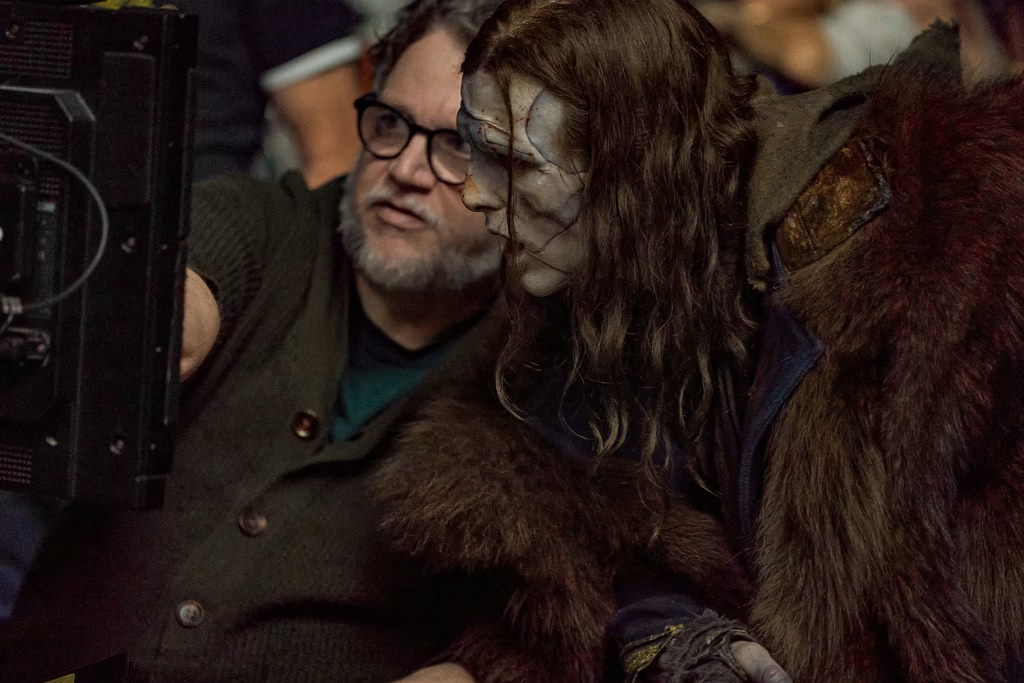
There is a reason Frankenstein still feels fresh in the age of advanced medicine and fast-moving tech. The novel was an early warning that capability grows faster than conscience. Del Toro’s film arrives in a moment when we can build almost anything and still pretend we are not accountable for what it becomes.
Isaac is well suited to this version of Victor. He can project sincerity and arrogance in the same scene, which is essential for a character who believes he is doing something noble while quietly chasing ego and immortality. Victor does not need to be a cartoon villain to be dangerous. He just needs one fatal blind spot.
The Creature as the Ethical Heart
Del Toro’s casting of Elordi signals a focus on the Creature’s interior life, not merely his silhouette. The power of Frankenstein has always been that the “monster” is capable of deep longing, intelligence, and pain. The moment we believe that, the ethics question sharpens.
If a being is sentient, then it is not an object. It is not a trophy. It is a moral relationship. The film’s emotional framing, echoed by the way the project has been discussed around its release, suggests that del Toro wants viewers to sit with that relational burden rather than escape into spectacle.
Is the Film Anti-Science?
Not really. The most compelling readings of Frankenstein do not argue that curiosity is evil. They argue that curiosity without humility is lethal.
Victor wants the glory of creation without the lifelong work of care. He treats life like proof of concept, not a bond. That feels painfully current in a culture that celebrates breakthrough moments and forgets the boring, essential maintenance that keeps people safe.
Bodies, Houses, and the Illusion of Control
Del Toro’s gothic style is doing philosophical work here. His worlds often pair beauty with decay, as if the set itself is warning you that perfection is a temporary costume. In Frankenstein, the laboratory becomes an ethical stage. The ritual of creation looks precise, almost ceremonial, until life refuses to behave like a machine.
The Creature’s very existence is an argument against Victor’s fantasy of total control. This is the story’s quiet genius. The moment a creator makes life, that life becomes unpredictable, opinionated, and hungry for meaning.
That shift changes the metaphor. Frankenstein is less like engineering than parenting. The creator does not get to pick only the flattering parts of the relationship.
Why This Version Hits Now

A global Netflix release means this story is reaching viewers who may only know the myth through cultural shorthand. The reach is huge, and the early awards-season visibility around the film suggests it is being treated as a major 2025 contender.
That context invites a broader conversation about what the film is really asking.
At heart, it is a story about power refusing to love what it has made. It can be read through science, class, family, religion, or technology. It can even be read through the modern fear that we are building systems that will outgrow our empathy.
The Grief Inside the “Playing God” Label
“Playing God” is a convenient accusation, but it can also be a dodge. It makes Victor’s failure sound grand and mythic when it is actually intimate and human. He fails at empathy and courage. He fails at accountability.
Del Toro seems to understand that the tragedy is not that a man dares to create life. The tragedy is that he cannot face the life he creates. The Creature becomes the fallout of that cowardice.
If this adaptation sticks with people, it will not be because it reinvents Shelley’s moral. It will be because it makes the moral feel personal again. The true horror is not the stitched body on the table. It is the loneliness that floods the room once the creator walks away.

Rachel Sikkema is a New Zealand-based writer and creative entrepreneur who explores the intersection of film, culture, and modern relationships. Through her articles, she examines how stories shape the way we connect, love and see ourselves – all for God’s glory. When she’s not writing about film and television, she’s watching Dexter and The White Lotus for the third time.